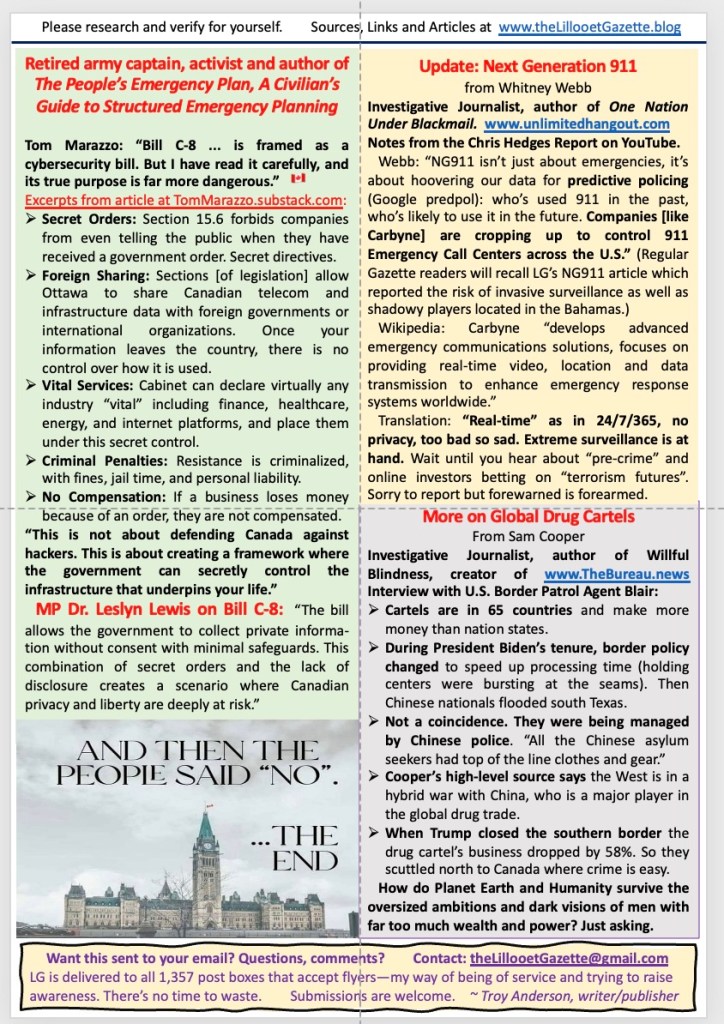
* Reading Notes: One Nation Under Blackmail Volume 2

One Nation Under Blackmail: The Sordid Union Between Intelligence and Crime that Gave Rise to Jeffery Epstein  By Whitney Webb 

Volume 1 Reading Notes are here. 

In this second volume, Webb zeroes in on Epstein’s closest circle of influence and chicanery while situating him amidst a global psychopathic brotherhood. The single most important thing to take away from her 1000-page tome, in my opinion, is that the so-called elite who run the world (99% are male) will make deals with anyone inside their network and a network is anything that increases their power, wealth and influence; no separation exists between and among mafia, organized crime, political parties, business, science, intelligence or military. Bear that in mind the next time the news tries to sell you their fictions. 

Publisher’s Forward quotes Bush’s Senior adviser, who told Ron Suskind, New York Times, 2004:  We’re an empire now, and when we act, we create our own reality. And while you’re studying that reality—judiciously, as you will—we’ll act again, creating other new realities, which you can study too, and that’s how things will sort out. We’re history’s actors … and you, all of you, will be left to just study what we do.

[Most mainstream media declined to dig deeper into Epstein’s connections [or were prevented] to the CIA and Israeli intelligence], instead largely focusing on the salacious aspects of the Epstein case. In addition, also in the early 1990s, Epstein’s name was mysteriously dropped from a major investigation into one of the largest Ponzi schemes in history even though he was labeled the mastermind of that swindle in grand jury testimony. Around the same time, subsequently released White House visitor logs show that Epstein visited the Clinton White House 17 times, accompanied on most of these visits by a difference, attractive young woman. (viii) 

This two-volume book endeavors to show why Jeffery Epstein was able to engage in a series of mind-boggling crimes for decades without incident. Far from being an anomaly, Epstein was one of several men who, over the past century, have engaged in sexual blackmail activities designed to obtain damaging information (i.e. intelligence) on powerful individuals with the goal of controlling their activities and securing their compliance. Most of these individuals, including Epstein himself, have their roots in the covert world where organized crime and intelligence have intermingled and often cooperated for the better part of the last 90 years, if not longer. Perhaps most shocking, these men are all interconnected to various degrees in networks and associations. (ix)

While the sex trafficking activities of Epstein and Maxwell are discussed at length and examined in depth, this book gives particular attention to the dramatically under-reported relationship that Jeffery Epstein had with the Clinton White House from 1993 to 1995 and the significance of his 17 known meetings. Epstein brought many attractive young women with him to these meetings and many of his meetings were with a man named Mark Middleton. Middletown, who died under suspicious circumstances in May 2022, was embroiled in foreign espionage activities at the time he was meeting with Epstein. Those activities were later investigated by Congress in relation to illegal fundraising efforts for Bill Clinton’s 1996 re-election campaign. Epstein’s activities at the the Clinton White House, and in other parts of the country during this same period in time, point toward a major scandal of the Clinton era that has yet to be properly investigated. (ix) 

Hoffenberg has also asserted that Epstein, in the early 1980s, “was trained in arms trafficking and money laundering by Adnan Khashoggi and Sir Douglas Leese jointly….Jeffery Epstein was a major participant and principal in the arms trafficking and money laundering operations of Adnan Khashoggi and Sir Douglas Leese, for Israel, for what they were doing in the United Kingdom.” Though it’s not exactly clear, Thompson Ramo-Woodbridge [aircraft parts and weapons components systems] seems to have been Leese’s introduction into the world of weapons dealing. Oddly enough, years later, a young Bill Gates, who would eventually develop his own ties to Epstein (see Chapter 20), would also get “his first break” thanks to TRW, when he worked “debugging grid control software for” the company at age 15. (12) 

Per his claims to several friends and as mentioned in more than a few press reports authored prior to his 2007 arrest, Epstein was working as a financial “bounty hunter” and helped both recover and hide stolen money on behalf of powerful people. (16)

Hoffenberg, who was found dead in his apartment in late August 2022, had notable confided in Edward Szall off the record that Epstein had had a relationship with BCCI [Bank of Credit and Commerce International], but did not provide any specifics. (17) 

In addition, in 1989, Khashoggi himself had been called by Vanity Fair “one of the greatest whoremongers in the world.” His biographer, Ronald Kessler, remarked in 1988 that “His [Khashoggi’s] whole modus operandi was to influence clients with his opulent lifestyle” and that “he would give them [potential clients] anything they wanted: girls, food, cash…He had quite a variety of occasions on the boat. Some were very formal, some were orgies.” According to the UK’s Independent, ‘One of the ‘girls’ used in this way, Pamella Bordes, later spoke of being “part of an enormous group…used as sexual bait,’” suggesting that Khashoggi commanded a veritable harem of women who were used to entice, or potentially coerce, would-be clients. However, these lists of “potential clients” also included notable politicians, diplomats, celebrities, and a cadre of businessmen. In the case of politicians and diplomats, it’s entirely possible that Khashoggi’s yacht was used as a means of collecting blackmail that Khashoggi used to benefit his network, or anyone willing to pay the right price. This was also alleged by the head of a highly-connected call-girl ring, Fortuna Isreal a.k.a. “Madame Tuna”. (17) 

Notably, Khashoggi’s infamous yacht would be sold to Roy Cohn’s protege, Donald Trump, in 1988, with the involvement of the Sultan of Brunei. The Sultan of Brunei would become Epstein’s landlord in the office he shared with Evangeline Gouletas-Carey and, as we will see in Chapter 19, the Sultan of Brunei makes other curious appearances in the Epstein-Clinton relationship. (18) 

Furthermore, given that Khashoggi was affiliated with Saudi, American, British, and Israeli intelligence by 1982, it is also possible that Epstein made his way into the fold of intelligence himself through Khashoggi. Epstein’s affiliation with some national intelligence agency was essentially confirmed in 2019, when it was reported that then-Secretary of Labor Alex Acosta, who had signed off on Epstein’s “sweetheart deal” during his first criminal case, had “been told” to back off Epstein, that Epstein was above his pay grade. “I was told Epstein ‘belonged to intelligence’ and to leave it alone,” Acosta repeatedly told the Trump transition team. (20) 

Hoffenberg told the Washington Post in 2019 that Leese had told him about Epstein. “The guy’s a genius…He’s great at selling securities. And he has no moral compass.” Hoffenberg, at the time, has admitted to having been “a schemer,” stating that he “was always under investigation,” well before Towers Financial Corporation collapsed and became known as one of the largest Ponzi schemes in US history. (26) 

Hoffenberg appeared in front of a Chicago grand jury, in November 1993, to which he confirmed while being questioned that “Jeffery Epstein was the person in charge of the [fraudulent] transactions.” Kohler’s line of questioning and overarching narrative at the hearing painted Epstein as the “technical wizard” of the Towers Financial fraud; yet, somehow, three months later, Epstein’s name mysteriously disappeared from the case. (28)

Hoffenberg was arrested in 1994 and pled guilty in April 1985. Hoffenberg had been offered a reduced sentence by prosecutors in exchange for information about co-conspirators, but either prosecutors were longer interested in pursuing Epstein or Hoffenberg chose not to talk about Epstein. Other Towers executives were charged for their role in the Towers Financial schemes, but Epstein was never charged. (29) 

As detailed in Chapter 9, the CIA’s modification of the PROMIS software was alleged to have taken place at the Cabazon Indian Reservation in Indio, California. Cabazon, at this point, was under the dominion of a mobster (and possible CIA asset) named John Nichols, who had managed to take control of the reservation from the tribal government after becoming the manager of a bingo hall—and projected casino project—at the reservation. The multi-faceted plan—which came to full fruition, despite a surprising number of dead bodies turning up along the way—included a scheme for an arms research, development, and manufacturing plant. It seems that the weapons made at Cabazon were to be deployed into the different theatres of the Reagan administration’s various covert wars. For instance, as previously mentioned, it is a matter of record that representatives of the Contras attended a meeting at Cabazon to observe a weapons demonstration. (42) 

The year 1987 was a pivotal year for Epstein, as it was the year he not only became involved with Hoffenberg and the Gouletas, but also with Donald Trump and Leslie Wexner. Both Trump and Wexner, at the time, were deeply involved in the worlds of New York real estate, as were the Gouletas. It was during this period that Epstein would begin branding himself a “property developer” and become focused on real estate deals, with numerous reports referring to Epstein as “a property developer” well into the 2000s. However, it seems that Epstein’s involvement with real estate may have been a new means of disguising his old financial tricks, as many of his real estate transactions during this period involved the same property multiple times, all for miniscule sums, including for as low as $1. (47)

Commercial real estate in the US has a long history of being used to launder money, and the practise is particularly common in specific American real estate markets like New York City and Palm Beach, Florida. These are notably two places where Epstein, as well as trump, have long been active in property markets. Trump and his inner circle, including the family of his son-n-law Jared Kushner, have long been accused of both permitting or engaging in money laundering in connection with their real estate interests, particularly in New York. Much of the money laundering accusations that would later dog Trump during his political career revolved around his alleged cooperation with Russian mobsters whereby those mobsters used Trump properties to launder their ill-gotten gains. However, while some in the mainstream press misleadingly painted this Russian mobster-connection as meaning Trump was “owned” by Vladimir Putin, it is important to note that the Russian mobsters in question connected back to Russian mob boss Semion Mogilevich. Mogilevich was a major business partner of Robert Maxwell [Ghislaine’s father, Guislane became Epstein’s girlfriend] and a key figure in the global criminal syndicate that Maxwell had helped to create at the end of the 1980s. (48)

After purchasing the Plaza Hotel, it would be reported and confirmed by then-attendees that Trump “used to host parties in suites at the Plaza when he owned it, where young women and girls were introduced to rich, older men” and “illegal drugs and young women were passed around and used.” (49)

The relationship with Trump would continue for some time, with Trump flying on Epstein’s place in 1997 and the two men being photographed together at a Victoria’s Secret party that same year. A year later, Epstein claimed to have introduced Trump to his current wife, Melania, at an event during New York fashion week. They would attend other parties together, including an event in 2000 hosted by media baron and convicted fraudster Conrad Black, who appears in Epstein’s book of contacts. Mar-a-Lago would figure prominently as a place of socialization for Epstein and Maxwell, as well as a place where they recruited minors into their sexual blackmail/sex trafficking operations, with the most well-known of these being Virginia Roberts (now Virginia Giuffre). (50) 

Those apartments at 301 East 66th Street would play a role in Epstein’s sexual trafficking and blackmail activities. For instance, Ehud Barak, former Israeli Prime Minister and Israeli military intelligence chief, was a frequent visitor to this location. Specifically, several apartments in the building were “being used to house underage girls from South America, Europe, and the former Soviet Union,” according to a former bookkeeper employed by one of Epstein’s main procurers of underage girls, Jean Luc Brunel.  (53)

Today, LS Power is a major supplier to Elon Musk’s Tesla, while Luminus Management was the largest shareholder in Valaris, which—in 2020—sold $650 million in oil rigs to Musk’s SpaceX. SpaceX plans to transform the rigs into rocket launching platforms. As reported by Business Insider, Jeffery Epstein had introduced a member of his entourage to Elon’s brother Kimbal Musk, who sits on the board of SpaceX and Tesla. The woman in question, who lived at an apartment at 301 East 66th Street and had previously “dated” Epstein, dated Musk from 2011 to 2012 and the relationship “brought Epstein into contact with the Musk family and its businesses.” In 2019, it was reported that Epstein had confirmed rumours to journalist James Stewart that he had been secretly advising Tesla. (55)

Michael Chertoff later became intimately involved in an Orwellian company funded by both Epstein and former Israel Prime Minister Ehud Barak named Carbyne911 whose founding leadership was replete with Israeli intelligence veterans and assets. (84) 

Klaus Schwab’s now infamous “penetrate the cabinets” quote may offer insight as to Leslie Wexner’s own interest over the decades in “developing leaders” in American Jewish communities, in Israel and beyond. With nearly 40 years focused specifically on training men and women of influence in American Jewish society—as well as in Israel’s government and private sector—ideas and policies that benefit Wexner both personally and professionally have been instilled into generations of leaders and influencers, who then go on to influence many others. Over the past two decades, Wexner’s foray into becoming one of the main donors of the Harvard Kennedy school allows for much the same to occur, but this time for leaders who operate and influence those far outside the boundaries of the global Jewish community. (124) 

The same year he and Epstein  began donating to Harvard, in 1991, Leslie Wexner teamed up with Charles Bronfman to establish an exclusive group of 20 of “the nations wealthiest and most influential Jewish businessmen” that is referred to as either the “Study Group” or the “Mega Group.” (124)

The 1990s saw a proliferation of Israeli espionage activity that targeted the highest levels of government, including the White House. FOX news reported: Israeli telecommunications company Amdocs helped Bell Atlantic install new telephone lines in the White House in 1997…[and] a senior-level employee of Amdocs had a separate T1 data phone line installed from his base outside St. Louis that was connected directly to Israel…

While this wiretapping for the purpose of blackmail took place, it is important to keep in mind that Jeffery Epstein had been visiting the White House, where he allegedly courted the president and influential White House officials, Congressmen and Senators. Former Israeli intelligence official Ari Ben-Menashe has alleged that Epstein’s sexual blackmail operation was created at Israel’s behest specifically to blackmail Bill Clinton. Ben-Menashe specifically said the following: The Israelis feared that Mr. Clinton, when he was campaigning for President, will be a repeat of Mr. Carter. He wanted to press them for peace with the Palestinians and all that stuff. …And I think Mr. Epstein was sent early on to catch up with President Clinton.   (130) 

In 1996, Leslie Wexner joined the board of directors of Hollinger International, a media holding company created by Conrad Black, a now disgraced media mogul who also makes an appearance in Epstein’s contact book. Black was the son of prominent Canadian businessman George Montegu Black, Jr., who managed a division of Argus Corporation called Canadian Breweries. (131) By the late 1970s, Conrad and his brother controlled the company. Between 1978 and 1985, Conrad Black asset stripped the conglomerate and used the spoils to build a major Anglo-American media empire, rivaling that of Rupert Murdoch and Robert Maxwell. A year later, he began aggressively acquiring US media assets, and, by the time Wexner joined the board, Black, via a Hollinger subsidiary, controlled 393 newspapers in US alone. Not long after Wexner joined the board of Hollinger, Conrad Black began to exhaustively defraud the company. It was later discovered that, from 1997 to 2004, Black stole approximately $400 million from the company, “a sum equal to 95 percent of the net profits for the period 1997-2003.”  (132) 

In this same 1985 period, Ghislaine also became involved with “philanthropy” tied to her father’s business empire by hosting a “Disney day out for kids” and benefit dinner on behalf of the Mirror Group for the Save the Children NGO. Part of the event took place at the home of the Marquess and Lady of Bath, a gala that was attended by members of the British royal family. It’s worth noting that the Marquess of Bath at the time was an odd person, having accumulated the largest collection of paintings made by Adolph Hitler and having said that Hitler had done “great things for his country.” The very same evening that the Ghislaine-hosted bash concluded, the Marquess of Bath’s son was found hanging from a bedspread tied to an oak beam at the Bath Arms in what was labeled as a suicide. (146)

Toward the end of her relationship with Cicogna, Ghislaine founded the Kit Kat Club, which she depicted as a feminist endeavor. Why Ghislaine chose the name “Kit Kat Club” is something of a mystery. The original Kit Kat Club was set up by a well-known pie maker named Christopher Catling in London during the eighteenth century to promote the freedoms obtained during the 1688 Glorious Revolution. Until the late 1800s, Catling’s organization was the only entity to use the name. Then, in the 1900s, various wealthy private clubs, music venues, and public houses adopted the name for establishments all around the UK. The original name of the club created by Catling was also the inspiration behind the naming of the famous KitKat chocolate bar produced by Nestle. (147)

There has since been speculation that Ghislaine’s Kit Kat Club is where Donald Trump met his future wife Melania. Although the New York Times and other outlets reported that, at Fashion Week 1998, Donald Trump first met Melania at the Kit Kat Club in New York… (148) 

Soon after her “painful” split from Gianfranco Cicogna, Ghislaine was seen skiing in Aspen, Colorado—”where the rich and famous mix” during the winter season—with American actor George Hamilton, who was also seen escorting Ghislaine to the Epsom races in 1991. Hamilton, twenty-two years Ghislaine’s senior, is apparently much more than just an actor, as he allegedly played a major role in aiding Ferdinand Marcos, the former dictator of the Philippines, and his wife Imelda move billions of public funds out of the country and convert them into private wealth for themselves and their accomplices abroad. Marcos originally rose to power with the help of the CIS and, as previously mentioned, Adnan Khashoggi—who worked with Epstein in the 1980s—was also close to the Marcos’s, specifically Imelda Marcos, and stood trial alongside her for his alleged role in aiding her in illegal financial schemes. (148) 

The Rothschilds’ interest in gaining a foothold in Wall Street seems to have been motivated by more than money. The Times report notes that “although the family staked valuable claims in Africa, the Middle East, and South America, they grossly mismanaged the opportunities directly across the Atlantic” and in the United States. It quotes Evelyn de Rothschild as saying, “We’ve been in business for 200 years, but we never seized the initiative in America and that was one of the mistakes my family made.” The New York Times also states, perhaps controversially, that “No other family in the annals of finance can match the Rothschild record for influencing the course of history, or its Machiavellian instincts for economic opportunity. (150) 

…the banking entity looking to help the Rothschild family “reassert its dominant role in international finance,” i.e. Rothschild Inc., was directing Robert Maxwell’s efforts to “establish a strategic presence in the United States” via a takeover of a major US-based publishing company. This intimate relationship between Rothschild banks and Robert Maxwell would again become evident as N.M. Rothschild was the group “called in to investigate his books and arrange the sale of his heirs’ 54 percent stake in Mirror Group Newspapers” after Maxwell’s 1991 death [murder]. (151) 

After Maxwell purchased Macmillan with the help of Pirie and Rothschild Inc., he used the company to establish his foothold in the United States, specifically New York City. There, he would being a sprawling influence operation to cultivate the city’s elite, which would soon intimately involve his daughter Ghislaine. With Macmillan under his control, he began using funds from the company’s charitable trusts, “spending lavishly on events in New York, paying large sums of money, sometimes as much as $100,000, for a seat at charitable functions attended by people he wanted to impress. He has acquired Macmillan for $2.6 billion, a sum “considerably more than his own Maxwell Communications Corporation was worth.” The amount of money he had to repay for this and other acquisitions of this period would become a factor in his infamous decision to pilfer the pension funds of the Mirror Group. (151)

Some speculated at the time that some of the funds Maxwell raised during this period for these acquisitions had originated in the Soviet Union, where had had considerable connections, including to the KGB. There are also the possibilities that some of the funds included proceeds from Maxwell’s sale of bugged PROMIS software to governments around the world on Israel’s behalf or, as previously detailed in Chapter 9, included profits from his business interests that were interlaced with notorious Russian mobster Semion Mogilevich. (151)

Tennessee Senator Howard Baker, best known for being the vice-chairman of the Senate Watergate Committee and subsequently Reagan’s chief of staff after the Iran-Contra scandal, had become Robert Maxwell’s business partner in 1991 in a venture called Newstar. Newstar focused on expanding investment opportunities for Americans in the former Soviet Union and was described by Richard Jacobs, who cofounded the company with Baker, as “an international merchant banking, investment, and advisory company.” Jacobs also stated that Robert Maxwell was one of the major shareholders in the company. Newstar just one of several companies that Maxwell used to enrich himself through privatizing assets of the former Soviet Union. Baker and Maxwell also attempted to recruit other respected public figures into Newstar, including the former top banking regulator in the US, William Seidman. (153) 

Soon after arriving in New York City, Robert Maxwell was determined to expand his footprint in there as well as to grow the influence of a Maxwell “dynasty.” His hopes to establish a dynasty were also described by the New York Post, which noted that Maxwell “saw himself as Britain’s Joseph P. Kennedy, the patriarch of a dynasty that would wield financial and political power on a global scale. Like Kennedy, he expected much of his children and pushed them hard.” (156)

One of the weddings Ghislaine attended was the June 1990 nuptials between Kerry Kennedy, daughter of Robert F. Kennedy, and Andrew Cuomo. Cuomo, the son of New York governor Mario Cuono who would later become governor of the state himself, was said to have treated the planning of the wedding “like a political campaign” and, not unlike Robert Maxwell, had allegedly sought to marry into the Kennedy political dynasty for personal gain. (157) 

However, it is worth noting that Ghislaine Maxwell’s and Jeffery Epstein’s subsequent influence and blackmail operations, beginning in 1991, had largely targeted politicians and prominent figures within the Democratic Party. Given this context, it is also entirely possible that Robert Maxwell and his network, including organized crime networks and intelligence services, were looking for a launching pad to more broadly influence the Democratic Party before Maxwell’s death—and what better way to do that than marry into the most prominent (and respected) of Democratic political dynasties. (157) 

Robert F. Kennedy Jr. also stated that the two occasions he was on Epstein’s plane had been arranged between Ghislaine Maxwell and Mary Richardson. In one instance, the flight was part of a pre-planned fossil hunting trip to South Dakota, which he believed had been Ghislaine’s idea as Epstein appeared to only have attended “grudgingly.” On that trip, Kennedy remembered that Epstein “did not mingle with us and hardly spoke and did not participate in the fossil hunt.” One one of the flights, the return trip to New York from South Dakota, Epstein “clearly” had a problem with Kennedy’s “rambunctious children” and “half way back to New York, Epstein ordered the pilot to put down at Midway Field in Chicago. He got off the plane and made his own way home. A blonde was waiting for him at planeside in Chicago”. (159) 

Among other questions that emerge when considering Ghislaine’s efforts to court at least two Kennedy men—would she have continued to court a Kennedy, or perhaps a Democrat politician of influence, if her father had not died so abruptly in late 1991? Indeed, Robert Maxwell’s planned trajectory, not just for himself but for his “dynasty”, was in tatters after his death, particularly as his financial crimes were revealed, permanently staining his legacy. Indeed, numerous reports have alleged that it was the chaos after her father’s abrupt death that drove Ghislaine so publicly into the arms of Jeffery Epstein. (159) 

Kroll was unable to give Robert Maxwell the information he had wanted [if there was a conspiracy to ruin him financially and destroy his empire] before Maxwell died under suspicious circumstances on his yacht in November 1991. Though media reports often say that his death was most likely a suicide, several biographers, investigators, and Ghislaine herself assert that he was murdered, having hit the end of the line in terms of usefulness to those who had empowered his legal and illegal activities over the years. Many of them have asserted that “rogue” Mossad agents had been responsible, including Ghislaine herself. Ghislaine reportedly blames “a dark conspiracy of Mossad renegades and Sicilian contract killers” for taking her father’s life. (160) 

Throughout the 1990s, Maxwell described herself to the press as an “internet operator.” She and a few family members to found an internet services company called the McKinley Group. It’s not hard to see why Christine and Isabel [Ghislaine’s sisters] saw the internet as their chance to expand upon and rebuild upon Robert Maxwell’s “legacy.” Christine, right up until her father’s death, had been president and CEO of the Robert Maxwell-owned Israeli intelligence front company, Information on Demand, where Isabel had also worked. Upon his death, Christine had founded a related company called Research on Demand, which specialized in “internet and big data analytics” for telecommunications firms, and would later overlap with the McKinley Group’s work. (162) 

Ghislaine and Jeffrey Epstein’s public relationship is believed to have officially begun in 1991 during a tribute dinner at the Plaza Hotel in Robert Maxwell’s honor, where Epstein sat at the same table with Ghislaine and Betty Maxwell. According to media reports, this was Ghislaine’s “first step in publicly announcing her deep affection for Epstein. The choice of the Plaza would prove to be ironic given that Epstein and Ghislaine were beginning an extensive sexual-blackmail operation that would go on for well over a decade. (165) 

The earliest official interaction between Epstein and the Clinton White House took place in 1993. For Epstein, it would be the first of 17 visits he would make to the executive residence in just under two years. (171) One of the top executives of Robert Maxwell’s main bank with “substantial responsibility” for at least one of his major financial crimes, was the person to first connect Epstein with the Clinton White House. [Robert Rubin] Furthermore, Rubin would become Treasury Secretary at the tail end of 1994, the year when Epstein made 12 of his 17 visits. While Rubin served as Clinton’s second Treasury Secretary, his deputy was Lawrence “Larry” Summers, who would later take over for Rubin as Treasury Secretary in 1999 and who, along with Rubin, helped engineer the repeal of the Glass-Steagall Act. This allowed an economic bubble to inflate, ultimately resulting in the 2008 crisis. Epstein is also alleged to have played some role in the 2008 financial crisis by apparently helping to instigate the collapse of Bear Stearns. (172) 

Fostergate. Grabbe’s investigation found it unlikely that this woman had been responsible for Foster’s death, which would mean their meeting was likely related to the Fostergate allegations regarding Foster and espionage on behalf of Israel. Grabbe’s investigation instead pointed to a “Bush plumbers unit” that continued to operate after Clinton’s election as having been responsible for Foster’s death. Grabbe notes that Foster’s murder had been sloppy and had “taken place under emergency conditions—a spontaneous, last-minute solution when Vince Foster failed to react in expected fashion to a $286,000 attempted bribe” [suspicion the hush money came from Hillary Clinton, involving CIA, money laundering and the usual bullshit during a White House heritage renovation project.] “We dumped him [Foster] in a queer park to send Clinton and his queer wife a message,” said FBI agent Robert Goetzman. (185) 

After Grabbe’s investigation into Fostergate and other issues, he was smeared by 60 Minutes’ Leslie Stahl as a source of “misinformation” online and an example of why Americans should not read reporting outside of mainstream media outlets, which are now owned by a small handful of companies and many of which are controlled by the intelligence-organized crime networks profiled in this book. Stahl’s segment sought to portray Grabbe, a Harvard-trained economist and former assistant professor of economics at Wharton Business School, as a loony “conspiracy theorist” without making an effort to factually challenge any of Grabbe’s reporting. Stahl argued the interest in Grabbe’s reporting was of the danger of allowing “just anyone” to post content onto the internet. 60 Minutes may have had a vendetta against Grabbe’s reporting on Fostergate as he had written, as part of that series, that 60 Minutes’ Mike Wallace (an attendee of parties on the Lady Ghislaine [Robert Maxwell’s yacht, named after his daughter] had been paid $150,000 by the Democratic National Committee to attack reporters who questioned the official narrative that Foster had committed suicide.  (186) 

Aside from the sudden death of Ron Brown and other Commerce officials, Mark Middleton—a central figure in the campaign finance scandals of the mid-1990s—would also, years later, suffer a grisly fate. He died on May 7, 2022 at a ranch in Arkansas owned by Heifer International, a non-profit whose funders included Walmart, Blackrock and the Bill & Melinda Gates Foundation. The local sheriff told media that, at the ranch, Middleton was found hanging from a tree branch by the neck with a shotgun blast to the chest. It was subsequently claimed by authorities that he had hung an extension cord around his neck before shooting himself in the chest with a shotgun. Despite the shotgun blast to hischest, police claimed there “was not a lot of blood or anything” at the scene. Speculation about Middleton’s death grewafter an Arkansas judge sealed all photos, videos, and visual content related to Middleton’s alleged suicide. (213) 

Shortly after Middleton’s death was reported, it was widely noted that he had been the official at the Clinton White House to sign off on many of Jeffery Epstein’s visits. The full extent of Middleton’s role in facilitating these visits had been made public only a few months before Middleton’s death, in December 2021. Thus, not only was Middleton the point man for questionable individuals with links to Chinese military intelligence seeking to gain access to the White House compound, he was also the point man for the intelligence-linked Epstein to do the same. This should be a clear indication that the real “Chinagate” scandal was much larger in scope than just China and the same can also be said of Mark Middleton’s activities at the time. (213)

With both Middleton and Epstein dead, it is exceedingly difficult to determine the exact nature and extent of their relationship as well as the subject of their White House meetings. Yet, Middleton’s major role in the campaign finance scandal is a critical clue. As it turns out, Epstein and other unsavory figures tied to Robert Maxwell were also involved in suspect fundraising and influence efforts during the 1996 campaign season in what is perhaps the other, less explored side of the so-called Chinagate scandal. (215) 

[Was Monica Lewinsky an operative?] Perelman’s controversial hiring of Hubbell and Lewinsky had been arranged by Clinton advisor Vernon Jordan…Jordan was known as Clinton’s “conduit to the high and mighty” and had taken Clinton to the 1991 Bilderberg conference. On the decision to hire Lewinsky following the scandal, a former business associate of Perelman’s told the Washington Post that “It’s like the Mafia, it’s all done in code,” adding that “I can assure you that Ronald made the decision to give Lewinsky the job. And I can assure you he wouldn’t want you to know why Jordan was asking.” (216)

As previously mentioned, the son of Esther Salas, the judge set to oversee a case against Deutsche Bank related to its role in enabling Epstein’s financial activities, was murdered right before that court case was to begin. (221) 

Thus, in 1991, we have a situation where Chinese arms giants, also major figures in technology transfer, were at a crossroads. They needed new markets for their weapons and, with the collapse of BCCIHK [international bank fond of dirty money laundering and intel agency smuggling, etc] they needed a new yet similar web of financial institutions that would aid them in the laundering and sequestering of  their profits. They found their new market, not in the Middle East, but in the United States. As the LA Times reported: “When [the Iran-Iraq] war subsided, the three companies [Norinco, Polygroup, and China Jingan, all Chinese companies] moved into the market created by the ballistic mayhem of American streets, selling primarily semiautomatic versions of the AK-47 and low-cost handguns modeled on more famous brands [like Colt and Smith & Wesson]. (247)

It turns out the ships used to smuggle the weapons seized via Operation Dragon Fire were owned by China Ocean Shipping Company (COSCO), the “merchant marine arm” of the People’s Liberation Army. A partner of COSCO at the time was Hutchinson-Whampoa, whose main shareholder was Li Ka-Shing. [Vancouverites will recall that Li Ka-Shing was the whale who bought the entire False Creek lands, which were then turned into Expo 86 and a rash of condo towers—the purchase spelled the beginning of the end of our beloved old Vancouver which soon thereafter was plagued by Chinese Triads and money laundering.] (251)

If Epstein’s meetings with Middleton were connected to Southern Air Transport’s activities [CIA smuggling cocaine into the US) during the same period, what would that mean? The Chinese network in which Middleton was enmeshed at the time was known to be engaged in smuggling weapons into the U.S. They simultaneously seem to have been paying off the DNC and the Clintons, a political dynasty notorious for pay-to-play politics. (254)

Those of us without national security clearances are left to look at a trail of crumbs, which seem to paint a certain picture and lead us to a particular conclusion. However, it seems that, unless greater pressure from the public [hahahahahaha] is applied to these concerns, the true nature of Epstein’s meetings with Middleton and the real motive behind Epstein’s courting of CIA-linked airlines on Wexner’s behalf will remain elusive. At the same time, as this book has labored to show, the US government is clearly in a position where it cannot investigate itself. Indeed, if any of these threads were to be pulled on, much of the excessive corruption, espionage, and criminal activity that has filled these pages thus far would quickly unravel. (258) 

Vasquez also testified that the teenage models that Brunel flew in to “work” for MC2 (and whose visas had been paid for by Epstein) were housed in the 301 66th Street apartment owned by Ossa Properties—the company of Mark Epstein, Jeffery’s brother. Vasquez stated that the girls were then “loaded out to wealthy clients” for as much as $100,000 a night. If they refused to have sex with the “client”, then they weren’t paid. Brunel denied these claims, but they were notably corroborated by the most well-known of Epstein’s victims, Virginia Roberts Giuffre. In a 2014 court filing [before Virginia was murdered/suicided], Giuffre alleged that Brunel offered “girls ‘modeling’ jobs. Many of the girls came from impoverished backgrounds, and he lured them in with a promise of making good money.” She also alleged that she was forced to have sex with Brunel of several occasions. She also stated that Epstein imported underage girls from France with Brune’s assistance, including 12-year-old triplets he had flown in from France so he could abuse them as a “birthday present” to himself. (266) 

Epstein is believed to have had many of his underage victims photographed in the nude, pictures which were displayed all over his Palm Beach mansion when it was first raided by police in 2005. He was never charged, nor have any of his accomplices ever been charged, with child pornography. Police also found that clocks in parts of the house had contained hidden cameras which filmed many of the girls while inside the house and potentially some of their sex acts with Epstein and his wealthy “friends”. Those images were stored on a computer hard drive also found in the residence. Vanity Fair reported that Ghislaine had openly stated that, in addition to Epstein’s residences in Palm Beach and New York, Epstein’s “island had been completely wired for video”… as an insurance policy, as blackmail. Brunel, like Epstein himself, died under what some regard as suspicious circumstances while in prison. Brunel was detained in December 2020 in connection with a French investigation into Epstein’s sex crimes in that country and was found hung in his cell in February 2022. The death was quickly ruled a suicide. (268) 

Other girls were offered a mix of money and promises that Epstein could help them receive an education at places like Harvard. In court testimony from 2021, a victim referred to as Jane Doe #11 stated that: “He promised me that he would write me a letter of recommendation for Harvard if I got the grades and scores needed for admission. He word was worth a lot, he assured me, as he was in the midst of funding and leading Harvard’s studies on the human brain, and the president was his friend. [Another woman, formerly a model, who was seduced by Epstein became a neuro-surgeon and is now ensconced in the World Health Organization and WEF] Epstein, once in a locked room with Jane Doe #11 after luring her in with such promises, threatened to kill her and then raped her. (273) 

Other victims of Epstein’s have stated that, in addition to luring girls in with promises to help them, Epstein also perversely claimed to some of his victims that being sexually abused by him was also a form of “help.” One victim, identified as Jane Doe #9, stated that “When I was 15 years old, I flew on Jeffery Epstein’s plane to Zorro Ranch, where I was sexually molested by him for many hours. What I remember most vividly was him explaining to me how beneficial the experience was for me and how much he was helping me to grow.” (275)

Carbyne911, formerly Reporty, is an Israeli tech-start-up founded in 2014 that promises to revolutionize how calls are handled by emergency service providers, as well as by governments, corporations, and educational institutions. Prior to Epstein’s arrest in mid-2019, Carbyne had received high praise from US and Israeli media. Other reports claimed that Carbyne’s services result in “a 65% reduction in time-to-dispatch” for emergency services. (359) 

Privacy concerns with Carbyne go beyond the company’s ties to Israeli intelligence and US intelligence contractors like Peter Thiel’s Palantir. For instance, Carbyne’s smartphone app extracts the following information from the phones on which it is installed: Device location, video live-streamed from the smartphone to the call center, text messages in a two-way chat window, any data from the user’s phone if they have the Carbyne app and ESInet, and any information that comes over the data link, which Carbyne opens in case the caller’s voice link drops out. According to Carbyne’s website, this same information can also be obtained from any smartphone, even if it does not have Carbyne’s app installed, if that phone calls a 911 call center that uses Carbyne or merely any other number connected to Carbyne’s network. Carbyne is a Next-Generation 9-11 (NG911) platform and the explicit goal of NG911 is for all 911 systems nationwide to become interconnected. Thus, even if Carbyne is not used by all 911 call centers using an NG911 platform, Carbyne will ostensibly have access to the data used by all emergency service providers and devices connected to those networks. (361)

Epstein was also working to build up a company focused around “DNA data-mining.” Created in 2012, Southern Trust was a “start-up” created by Epstein with the apparent goal of sequencing people’s genomes and selling that data to the pharmaceutical industry. In 2012, Epstein seemed to know something that those guiding other, more prominent “data mining” firms like Chiliad and Palantir also knew—that, soon, data would become the world’s most valuable commodity. This would become a common public talking point in the years that followed. For instance, in 2017, The Economist declared that the world’s most valuable resource was no longer oil, but data. Referring to data as “the oil of the digital era”, it notes that this new “data economy” runs on masses of data generated by billions of devices as well as algorithms, particularly Artificial Intelligence algorithms. It also notes that the “data economy” is intimately linked to Big Tech’s “surveillance systems”, which gives these powerful companies a “God’s eye view” of both markets and citizens behaviour. (372) 

Epstein’s decision to court and gather “dirt” on Big Tech scions, while also rebranding as a tech investor and entrepreneur, was carefully calculated. Indeed, he and the Maxwells were intimately aware of h ow the digital revolution was drastically reshaping the face of blackmail and influencing operations. Arguably beginning with the PROMIS software scandal, which intimately involved the Maxwells, the utility of bugged software to intelligence agencies quickly became obvious. With a few lines of surreptitious code, intelligence agencies could gain access to troves of sensitive data in real-time, which previously would have required scores of highly embedded and sophisticated spies. Yet, those spies could be caught if just one in their network slipped up. However, with a few lines hidden among thousands and thousands of line of code, a software program’s “treachery” is much more difficult to detect. While Epstein and the Maxwells, throughout the 1990s and beyond, blackmailed powerful people using trafficked women and girls, the digital revolution offered them, and their benefactors, a new opportunity to fulfill the same operational goals, but with much less risk. (372) 

In a world where blackmail is overwhelmingly electronic, people like Epstein and Ghislaine become liabilities to be silenced, rather than assets to protect. Another critical consequence of the advent of electronic blackmail is that the very same systems that enable that blackmail to occur are intimately enmeshed with the infrastructure of mass surveillance. This is the core idea behind the panopticon model. (373)

While the US has long been “one nation under blackmail”, the perpetuation of this system and means of control is rapidly reaching its logical conclusion. The more we live our lives on our phones and our computers, the more we can be exploited if and when certain groups and networks with access to our data decide that they want something from us. Yet, now that these corrupt power structures have grown so accustomed to our digital dependence, we now have the chance to disrupt the empire that they have built on a foundation of blackmail, bribes and bullet. By taking ownership of our data, and depriving intelligence-linked Big Tech their monopoly of control over it, we can start to rupture a system that would enslave us if allowed to advance. (374)

When one  realizes where power really lies and how it really functions, it becomes clear that the only way to deter a corrupt system of this magnitude, which has now merged public and private power into the hands of the few, is not to comply. The government is no longer capable of investigating itself and our institutions have long been too compromised to guarantee American well-being or the American way of life. Instead, quite the opposite had taken place. The US, after being used by these networks to loot countries around the world, has itself been looted and hung out to dry…as this book has endeavored to show, non-compliance is a must when facing a system that, among other crimes, is willing to enable and engage in the unconscionable exploitation and abuse of children to further its stranglehold over the country, and ultimately over us. (375) 

-30-
* Wildfires. A letter sent to all BC Municipalities

From: S. Troy Anderson, Concerned Citizen, Researcher, Published Writer

Sent: August 28, 2026

To: Mayors and Councils, All BC Municipalities, UBCM, BC Fire Chiefs

Subject: Exploding Wildfires and the Urgent Need to Stop Chemical-Induced Weather Experiments

To All it may concern,

Another summer of communities evacuated, 1000s of people losing their homes, massive fires burning out of control, smoke-filled air for weeks and months. Tremendous resources—human and financial—go into fighting fires that become larger, more volatile and greater in number every year. The strain on families, communities, business, tourism, health, and taxpayers is excessive. We’re continually told the crisis is due to climate change but this is not the whole picture. 

Recently, a Fire Chief told a CBC reporter that the Bald Range wildfire near Summerland doubled in size so fast that firefighters could do little but order over 12,000 people to evacuate. He said the fire “exploded”. CBC news presenter, Johanna Wagstaffe, said, “I’ve never seen anything like this as a meteorologist.” Back in 2018, during California’s deadliest-ever fire season, their exasperated Fire Chief told a reporter the “fire behaviour has changed, the fires are exploding.” And it gets worse. We’re now seeing fire tornadoes and on the weekend of August 22nd over 7000 lightning strikes! 

This must be our call to action. It’s time to question why billions of pounds of flammable chemicals are sprayed into earth’s atmosphere every year—for over 50 years—and how this is contributing to exploding wildfires, extreme weather events, and other problems.

They call it ‘geoengineering’. Mexico has banned it. Seven American states have also banned it. Lawmakers in over 30 states are in the process of criminalizing atmospheric manipulation or climate intervention. Legislative bills are currently wending through the U.S. political system: New Jersey’s Bill 4161 “seeks to ban the release of hazardous chemicals for geoengineering”; North Carolina’s Bill 362 “amends environmental laws to bar intentional chemical releases for weather or sunlight manipulation”; Montana “prohibits releasing chemicals to alter weather or sunlight intensity”; Florida is “protecting natural weather patterns.” 

According to their Material Safety Data Sheets (MSDS), the flammable chemicals being sprayed fundamentally conflict with fire, water and fire-fightingAluminum Particulate “reacts violently and/or explosively with water, steam or moisture.” Barium: “Contact with water releases flammable gases which may ignite spontaneously.” With Sodium Chloride, “avoid excess heat and exposure to moist air or water” or the chemical will explode. Sulphur dioxide “may explode if heated.” When using Silver Iodide, “excess heat is a condition to avoid—no data available for explosive limits.” Potassium Chloride must be “kept away from heat or sources of ignition.” Calcium Carbonate“may explode when heated” and “should not be released into the environment.” Aluminum Strontium “should not be released into the environment. Do not allow product to reach ground water, water course or sewage system.”Manganese: “keep away from heat, sparks or open flames.” Titanium Oxide, which are nano-particles, “must be kept away from open flames and sources of ignition.” Aluminum oxide: “avoid excessive heat.” And more. 

Canada has no domestic laws prohibiting chemical experiments involving solar radiation, weather modification or climate intervention. What we have is a Canada/U.S. Weather Modification Treaty, formed in 1975. (Verification documentation at the end of this letter). Canada’s only oversight over our skies is the toothless Weather Modification Information Act which politely asks only to be informed of what’s already been done. See UBC’s Bertram Research Group website for their active involvement in the region.

It must be noted that climate geoengineering makes $5 trillion in sales for the chemical industry every year. They sell both the flammable chemicals that can cause explosive fires and the dry chemicals they advise are “suitable for extinguishing” them. MSDS for flammable chemicals have pages and pages of missing data: “toxicological properties have not been fully investigated.” Effects on human health: “no information available.” Product flammability, burning rate, or explosion limits: “no information available.” Ecological information: “no information available.” No data for chemical stability or reactivity. After more than 50 years, there’s no information pertaining to downsides and negative effects? Or is that information being hidden?

We all know the history of industries claiming their products are safe and harmless, then it turns out they’re not. Thalidomide, big tobacco, and opioids are three of many examples. Corruption repeats—as do reaction patterns. When harms become evident, industries typically ignore, deny, explain away, and cover up; vested interests and profits are prioritized. Nothing changes until dedicated researchers and whistleblowers expose the facts to the people, who then organize and demand change. It’s not our fault if we didn’t know, or if we trusted and believed what they told us. But it is our fault if we learn the truth and kick the can down the road. 

We need everyone to share information, band together, call for government transparency, and demand a moratorium on chemical climate experimentation. The upcoming UBCM conference would be a good opportunity. You are our best defense. You can protect our health, our lives and livelihoods, our communities, our firefighters, our clean and clear atmosphere, our land and waterways, our shared future. 

Thank you for your honourable service and your attention to this urgent issue. Links to primary sources, documentation and high quality research listed below.  

Respectfully,

S. Troy Anderson

Lillooet, BC, V0K 1V0

Email: theLillooetGazette@gmail.com

Primary Source Documentation for Verification and Research 

Type or Copy/Paste into the search bar of your preferred Search Engine (Google, Firefox, Safari, Brave, etc)

1975 Weather Modification Treaty between Canada and U.S.  

Canada Weather Modification Information Act 

Bertram Research Group: UBC Chemistry Department

Material Safety Data Sheets and the chemical name – MSDS and Aluminum Particulate

State-level geoengineering bans: Florida, Montana and Beyond

Is geoengineering pushing us into climate chaos

Geoengineering Watch has been documenting this for over 20 years. See their excellent documentary, Hacking the Planet: the Geoengineering Reality

Chemtrails Exposed is a database of photos of climate experimentation, uploaded to the internet from concerned citizens all over the world.

Center for International Environmental Law Expose the Dangers of Geoengineering on Substack

EPA Releases New Online Resources Giving Americans Total Transparency on the Issues of Geoengineering and Contrails

Controversial Geoengineering Test Quietly Launches Salt Crystals into Atmosphere

* Reading Notes: One Nation Under Blackmail by Whitney Webb

I’ve read it twice, so you don’t have to—though I would recommend you do. Webb is a brilliant researcher with encyclopedic knowledge of the historical development of global corruption and crimes, the players involved, and their connections to one another. All is not what it seems! Here are the Coles notes. 

One Nation Under Blackmail Volume 1 ~ the Sordid Union Between Intelligence and Organized Crime That Gave Rise to Jeffrey Epstein by Whitney Webb

In order to understand Jeffery Epstein and his activities in their full context, one must understand his powerful contacts and the structures that protected him. Those structures and those networks did not begin with Jeffery Epstein and they also did not die with him. In revealing his broader milieu, and that of his past associates and clients, one is left not only with a damning indictment of Jeffery Epstein, but also a damning indictment of American institutions, particularly those involved in “national security” matters and law enforcement. We cannot properly address the crimes of Jeffery Epstein, nor prevent them being committed by others in the future, unless we grapple with the covert power structures that have long wielded blackmail, bribes and assassinations as their weapons of choice to corrupt and control public institutions while manipulating and looting the public. JE was not an anomaly and his activities represent just the tip of the veritable iceberg. (ix)

Former CIA officer and Iran-Contra whistleblower Bruce Hemmings, circa 1990: “If you let them, they will take over not only the CIA but the entire government and the world, cutting off dissent, free speech, a free media, and they will cut a deal with anyone, from the Mafia to Saddam Hussein, if it means more power and money. (x)

Operation Underworld [WWII, where the U.S. government decided to enlist organized crime members in their operations], which the government was forced to reluctantly acknowledge after decades of public denials, involved the recruitment of high-level organized crime figures for work with American intelligence services, justified by wartime necessity. (2)

The National Crime Syndicate might be best understand as a social network—a sprawling, faction-filled web of associations and organizations that either collaborated or competed, depending on the situation of the spoils. (4) 

Lurking in the background of Operation Underworld, which has seen the ONI directly recruit [Lucky] Luciano, was the Office of Strategic Services (OSS), the wartime forerunner to the CIA and America’s first robust national intelligence organization [WW2]. (5)

[China involved in big pharma right from the start.] The Green Gang [who rose of power after Beijing tried to squash their grassroots trading empire] financed its activities through the cultivation and sale of opium—an activity that was fully sanctioned by Chiang Kai-Shek and the Kuomintang (KMT). Prior to the KMTs rise to power, Chinese opium production was unorganized, distributed among many different warring figures. Under Chang, however, a “suppression” was carried out with the ostensible goal of wiping out the opium trade in the name of public health. Behind the scenes, however, the KMT was doing quite the opposite: the “suppression” of opium production was actually an integrated effort to centralize it, placing production, distribution and ultimately control of the substance in the hands of a joint KMT-Green Gang monopoly. (11) 

Support for the KMT opium monopoly came from Western modernizers—including the Rockefeller Foundation, which had set up shop in China during the 1910s with the creation of the China Medical Board. At the same time, it was also part of a larger tendency among internationalists like the Rockefellers to seek regulation and control of the global drug trade. The overarching imperative of the League of Nations efforts for global drug regulation was to rationalize the production of opium and other precursors and to consolidate drug refining and distribution within a series of select major pharmaceutical corporations. Under Chiang’s leadership, China simultaneously kowtowed to the League’s initiatives while using the monopolization drive to cement itself at the center of drug production for both the criminal underworld and the “legitimate” overworld. A full-blown narco state was in the process of being formed, as opium cultivation came to be the central focus of the government’s revenue-raising programs. (11) 

The Supermob. The global drug trade is a massive business, and the offshore banking system that enables it is even bigger. Although most imagine drug networks, their controllers and their users as existing on the fringes of society, in reality, the massive amounts of capital that result from the production and distribution of illicit drugs occupy a central place within the global economic system. Consider a statement made in 2009 by Antoinio Maria Costa, who was then head of the UN Office on Drugs and Crime. According to Costa, proceeds from the drug trade were an important source of liquidity for cash-starved banks at the height of the 2008 economic crisis. The amounts absorbed by the banking system were enough to prevent some banks from collapsing. (22) 

The UN Office of Drugs and Crime estimated that money laundering activities—encompassing the washing of illicit drug revenue and more—make up anywhere from 2 to 5% of global GDP, at around $800 billion to $2 trillion. This, again, is almost certainly a conservative estimate. (22) 

What makes the “Supermob” unique is that it was a particularly stark and fairly unmasked example of how criminal networks, political power, and “legitimate” commercial activity mixed together in the period of explosive economic and cultural growth in the wake of WW2.  (24)

William Mellon Hitchcock was one of the financial backers of the Brotherhood of Eternal Love, the so-called “hippie mafia” that produced and distributed psychedelics on an international scale. (33) See Acid Dreams: The Complete Social History of LSD: The CIA, the Sixties and Beyond by Lee & Schlain

Castle Bank was a melding of worlds. A blossoming of heroin traffic coming out of Southeast Asia and a complicated money laundering operation that silently moved the funds of powerful gangsters, politicians, businessmen, and intelligence services around the globe. (33)

Carefully removed from the official Watergate narrative is Woodward’s stint, immediately prior to his career as a journalist, in the military. After attending Yale, Woodward had gone into the Navy, where he spent “four years of sea duty as a communications officer”. He served under two superiors who would go on to land important positions at the Pentagon. In August 1969, Woodward, still an enterprising young naval officer, arrived in Washington, DC. (179)

Clearly, this emergent network was like an octopus, with far-reaching tentacles reaching out in all directions and intertwined with seemingly legitimate businesses. …a strange, darker underbelly… (211)

Saudi Arabia was lending its Egyptian allies large sums of money, which were then used to purchase French-produced weapons that soon flooded African conflict zones. (220) 

At the end of the war [WW2], Donovan organized a committee to advise Hollywood on the production of spy-themed movies. The members of this special commission included Daved K.E. Bruce, J. Russell Forgan, Allen Dulles, and Shaheen. Their efforts successfully inserted a score of OSS veterans into the movie business, while also giving directors and producers a direct link to the inside world of wartime-intelligence operatives. Hollywood, as a result, became yet another milieu where the worlds of American intelligence intersected with organized crime. (250) 

When Nixon had briefly returned to private law practice, Shaheen had been one of his clients. He was responsible for connecting Nixon with Joey Smallwood, the premier of the Canadian province of Newfoundland. Smallwood, meanwhile, was engaged in an effort to industrialize the remote province by courting European and American capital. Some of the firms he courted bore the unmistakable mark of organized crime—for example, the controversial John C. Doyle and his company, Canadian Javelin. (250)

Thus, BCCI supported the work of A.Q. Khan, a Pakistani nuclear physicist and engineer known as the father of Pakistan’s weapons program. This work had begun after India tested the “Smiling Buddha,” their own nuclear weapon, in 1974 and it was carried out under the auspices of Khan Research Laboratories. Pakistan and Iraq had an experimental weapon called a “Columbine head”. Columbine heads were allegedly a type of thermobaric bomb, better known as a “fuel air explosive,” as they suck in the surrounding air to create a powerful explosion. (271) 

During the 1980s, Singlaub headed the US Council for World Freedom, the US branch of a global network of spies, criminals, Nazi exiles, fascist operators, and death squad leaders belonging to the World Anti-Communist League. By 1984, he was serving as the chairman of the league itself. The World Anti-Communist League and the US Council for World Freedom were interlaced with a host of like-minded pressure groups, dark-money fronts, private-intelligence apparatuses, and closed-door meeting places. These groups pressed for rolling back Cold War policies and boosting defense spending. More specifically, the pushed for the continuation and deepening of covert wars across the world; free trade policies, and other packages beneficial to multinational corporations; and the curtailing of civil and labor rights. Some of these, such as the American Security Council, appear to have participated in psychological operations aimed at the domestic population of the United States as well as abroad. (292)

A key aspect of the covert operations of the Reagan era that is frequently overlooked is that, with respect to the complex trafficking of arms to Iran, Oliver North and the Enterprise were dipping their toes into a much wider swamp of political and economic corruption, arms trafficking, and money laundering on a truly colossal scale. As the conflict between Iraq and Iran heated up, companies, banks, intelligence agents and smugglers poured arms and military materials into both sides of a bloody war. Despite laws barring such activities, the conflict in the Middle East was a boom time for many. (306) 

Space Research Corporation is best remembered for the man behind the company: Gerald Bull, a Canadian-born engineer and artillery expert who, prior to his 1990 assassination in the doorway of his Brussels apartment, had designed weapons systems for the Iraqis and the Chinese. He had also brokered the sale of arms to South Africa. Yet, his most famous effort was Project Babylon. Commissioned by the Iraqi government, Project Babylon was intended to construct a series of space guns, based on Bull’s earlier designs for launching satellites into orbit. These guns would be used to fire projectiles high into the atmosphere or near-earth orbit in order to reach targets far beyond the range of normal artillery equipment. (318) 

[A note on the exhaustive research Webb has brought to bear in this tome: one chapter, A Killer Enterprise, has 267 end notes! Each chapter is chock-a-block full of citations and documentation.)

[The book details the unbelievably byzantine labyrinth of a global toxic brotherhood]… “which paints a complicated picture of the unstable alliances and power competitions that raged beneath the surface of the this covert world”. (341) 

One of the most brazen and successful operations ever conducted by Israeli intelligence on a global scale involved its sale of a bugged software program to governments, corporations, and major financial and scientific institutions around the world. That software program, known as the Prosecutor’s Information Management System or PROMIS, was originally created and marketed by Inslaw Inc., a company created by former NSA official Bill Hamilton and his wife Nancy. In 1982, Inslaw leased its revolutionary PROMIS software to the US Justice Department, then headed by Edwin Meese III, Ronald Reagan’s most trusted advisor, Attorney General and, later, an advisor to Donald Trump following the 2016 election. The success of the software, which allowed integration of separate databases and information analysis on a previously unimaginable scale, eventually caught the attention of Rafi Eitan, the notorious and legendary Israeli spymaster as well as the handler of the “most dangerous spy” in American history, Jonathan Pollard. The PROMIS software could track anything, specifically money and people…This agreement between Eitan and Brian eventually led to two different versions of bugged PROMIS software, one bugged by Israel for the main purpose of spying on the operations of foreign governments and intelligence services and one bugged by CIA-linked entities and individuals for the main purpose of engaging in financial espionage and money laundering. (384-5)

Through Degem and other Maxwell-owned companies based in Israel and elsewhere, Maxwell marketed PROMIS so successfully that Israel intelligence soon had access to the innermost workings of innumerable governments, intelligence services, and corporations around the world. Many of Maxwell’s biggest successes came in selling PROMIS to dictators in Eastern Europe, Africa, and Latin America. Following the sale, and after Maxwell collected a handsome pay check, PROMIS’ unparalleled ability to track and surveil anything—from cash flows to human movement—was used by these governments to commit financial crimes with greater finesse and also to hunt down and disappear dissidents. Israel intelligence, of course, watched it all play out in real time. (386)

In Latin America, for instance, Maxwell sold PROMIS to military dictatorships in Chile and Argentina. There, PROMIS was used to facilitate the mass murder that characterized Operation Condo, as the friends and families of dissidents and so-called subversives were easily identified using PROMIS. PROMIS was so effective for this purpose that, just days after Maxwell sold the software to Guatemala, its US-backed dictatorship rounded up 20,000 “subversives” who were never heard from again. Of course, thanks to their backdoor in PROMIS, Israeli intelligence knew the identities of Guatemala’s disappeared before the victims’ own families. Israel, along with the United States, was also intimately involved in the arming and training of many of the same Latin American dictatorships that had been sold the bugged PROMIS software.  (387) 

Per Seymour, Riconosciuto had been recruited by the CIA while at Stanford University and Riconoscuito “and Earl Brian had traveled to Iran in 1980 and had paid $40 million to Iranian officials to persuade them not to let the hostages go before the presidential election”, a scheme better known as the October Surprise. Riconoscuito later testified that the software “was stolen as a favor to software-company executive Earl Brian, a friend of Meese’s, for Brian’s help in persuading the Iranian government to hold on to the embassy hostages until the 1980 election was over. (390) [In order to make residing president Carter look bad to the voters and lose.]

Systematics has had close ties to the NSA and CIA ever since its founding, sources say, as a money-shuffler for covert operations. It is no secret that there were billions of dollars moving around in “black” accounts—from buying and selling arms to the Contras, Iran, Iraq, Angola and other countries paying CIA operatives and laundering money from clandestine CIA drug dealing. Having taken over the complete computer rooms in scores of small U.S. banks as an “outsource” supplier of data processing, Systematics was in a unique position to manage that covert money flow. Sources say the money was moved at the end of every day disguised as a routine bank-to-bank balancing transaction. (396, footnote 67, James Normal articled called Fostergate) 

This focus on obtaining a secret window into the in and out-flows of the global banking system enabled not only the covert tracking of funds, but presumably allowed funds to be covertly hidden and financial crimes to be effectively covered up or rendered invisible. 

As previously mentioned, prior to Casolaro’s death [he was murdered], those close to the journalist had seen documents involving money transfers involving the World Bank to people involved in these scandals, such as Earl Brian and Adnan Khashoggi. In addition, it was reported by economist and author J. Orlin Grabbe that his particular version of PROMIS in use by the World Bank was being used to track wire transfers “in connection with a money-laundering operation that went from BCCI [Bank of Credit and Commerce International] London through the World Bank into Caribbean institutions. The role of the World Bank in the PROMIS scandal has been largely unexplored. (406-7)

One of the men who developed Neva alongside Maxwell, Ognian Doninov, president of the Bulgarian Chamber for Industry and Trade from 1980 to 1984 and Bulgaria’s Vice Premier from 1984-1986, claimed that Bulgarian intelligence agents involved in Neva had been covertly working “in Silicon Valley and other key technology sectors” in the United States, as well as in Britain and other Western countries. There, they would steal “technology blueprints, actual software, even computers. According to Gordon Thomas, Robert Maxwell created an umbrella of companies for use in Neva within six months. Thanks to Maxwell, Thomas writes, “The country had become […] the center of a thriving economy based upon whole-sale theft and money laundering.” This growing business empire, Thomas asserts would later “grown into one of the most powerful crime syndicates in the world, embracing the Russian mafia, the crime families of Bulgaria and, far away across the Atlantic, those in New York and, on the other side of the world, the crime families of Japan and Hong Kong. (412-3) 

John Patrick O’Neill, FBI executive agent-in-charge in New York until 2001, would later say the following about Maxwell and Multi-Group: in many ways Maxwell was at the heart of the global criminal network. Beginning with his Bulgarian connection he showed how to structure a network that grew into financially powerful criminal corporations whose power would extend to the South American drug cartels, the Tongs and the Triads, the Russian Mafia and the Japanese Yakuza. They were all there before. But the way Robert Maxwell set things up, they would all come together in Multi-Group in its early years. His last contribution was not that he just robbed his pension funds. It was that he was the man who set in motion a true coalition of global criminals. (413) 

[Reagan era schemes] Some have explained these specific scandals away, painting them as blights of the Reagan-Bush administrations and treating these intelligence-organized crime rackets as isolated incidents. However, instead, it appears that these intelligence-organized crime networks were so central to the national power structure by the time Reagan took office that the more well-known scandals of the era can be seen as “business as usual” for the period. Yet, lurking beneath Iran-Contra and other scandals that rocked the Reagan administration, there were darker and more nefarious activities that reached the highest levels of power during the same period, but received considerably less media attention. These other, lesser known scandals and crimes of the era show that, during the reigns of Reagan and Bush Sr., the rot reached all the way to the White House. Key power brokers in this sordid milieu included individuals intimately involved in the world of sex blackmail, who often bragged about their ability to “fix” and “manipulate” any politician or powerful individual they sought to influence, for the benefit of intelligence agencies, organized crime, as well as their own personal gain. (434)  

[Stay tuned for notes on Volume 2, when I’m done reading it.]

-30-

* Reading Notes ~ Wilful Blindness by Sam Cooper

All things wacko in the state of Canada, by one of our very best investigative journalists ~ written with style and integrity. Of the many things you’ll learn reading this book is that many of the Chinese whales who came to Canada own, or owned, mines in China. Some of them sold the mines in order to turn swaths of Chinese land into real estate which was so expensive it was too difficult for the Chinese to buy. They caused tremendous harms, uprooted communities and rendered many people homeless and destitute. Some of those whales brought their lust for more real estate scams; some of them became ranking members of the Communist Party; some are deeply embedded in Triads and all things illegal, including fentanyl, which is decimating Canadian communities. 

Wilful Blindness ~ How a Network of Narcos, Tycoons and CCP Agents Infiltrated the West by Sam Cooper 

Teng Biao, Professor and human rights scholar, in his forward to the book: An open society must not be exploited by dictatorial regimes to monitor the diaspora communities and to spread its anti-democracy propaganda. 

Regarding the detention and cruel treatment of Michael Spavor and Michael Kovrig by the CCP, “as an obvious retaliation for the detention of Meng Wanzhou. If Canadians have been shocked by the judicial blackmail, it is a wonderful opportunity to deepen their understanding of the characteristics of the regime..” 

After the Tiananmen Square Massacre in 1989, with the help of Western engagement, money, and technology, the CCP has established increasingly powerful and brutal totalitarianism domestically and has become more and more aggressive on the international stage and a threat to global freedom. Its extraterritorial laws and long arm of enforcement overstretch in many different ways. For example, its control of Chinese immigrants, its economic coercion, and its abduction of refugees overseas, including dissidents, booksellers, Uyghurs, and businessmen. It’s theft, bribery, and propaganda are institutionalized through the Asia Infrastructure Investment Bank (AIIB), One Belt One Road (BRI), South China Sea aggression, international cyber attacks and espionage, manipulation of the UN human rights mechanisms, and the “Thousand Talents Program”.” 

Calvin Chrustie: “It is a complex issue, but as stated yesterday [during a money laundering commission inquiry] while the flight of capital issue is a key concern, we know China’s financial elite have close ties to organized crime. And we also know the cartels are close to Chinese networks.”

Regarding underground banking, Cooper has extensively researched Silver International, located in Richmond, BC. “It was a stunning and terrible operation, laundering more than $1 billion each year in Vancouver for Chinese, Mexican and Iranian crime cartels. To my mind, Silver took on the shape of a financial weapon, a toxic creation that systemically eroded Canada’s economic foundations and the rule of law, while fulfilling the needs of transnational narcos and CCP oligarchs in elegantly balanced, symbiotic transactions—effortlessly shifting narco-dollars worldwide by leveraging massive reserves of corruption money seeking underground channels out of mainland China. 

There is no dispute among criminologists about the cartel’s profound influence in Vancouver’s conversion into a hub for transnational crime. A 2015 report prepared by Canada’s anti-money laundering agency Fintrac says: “Vancouver is a critical money-laundering hub for: international drug money; dirty money from China (drugs, corruption, tax evasion). Transnational criminal organizations and local drug money.” The report says Vancouver is especially vulnerable to money-laundering because of its proximity to China and the U.S., its hot real estate market, and its busy marine port, which has been stripped of regulation by provincial and federal government funding cuts. (32)  

“But if you focus on 1988, you have to zoon further back, all the way to China’s bloody Cultural Revolution and the year 1967, when overly aggressive members of Chairman Mao’s paratrooper Red Guards were purged and detained in Guangzhou. 

“It was in these internment camps that the Red paratroopers formed a new Triad-like society, the Big Circle Gang, and the prisoners eventually escaped to Hong Kong, where they made a violent impression on the original Triads that had already fled to Hong Kong and Macau in the 1950s and 1960s, after losing bloody battles with Mao and the Communists. (50)

In Canadian federal court records regarding Triad infiltration of Canada’s immigration system, the Hong Kong police force’s leading Triad expert, Stanley Ip, is cited explaining the ancient roots of these secret societies. According to Ip, governments in China have, to various degrees, confronted the Triads since 1674—when leaders from China’s Han ethnic groups formed sects to buck the authority of the Manchurian Qing dynasty. The Triads functioned like shadow governments, evolving into powerful criminal societies controlling underground channels of finance and trade, and enforcing contracts through guanxi (relationships) and violence. 

In the 1900s, secretive relations between national leaders and criminal leaders continued, Ip says, until Mao and the Communists firmly gained the upper hand and vanquished the Triads. But in the early 1980s, as negotiations progressed between the United Kingdom and China for the handover of Hong Kong, the pragmatic paramount leader Deng Xiaopeng had a new arrangement in mind. [China style capitalism] (50)

Sidewinder [1997 CSIS report] concluded that Canada faced a growing national security threat of economic infiltration driven by a network of allies from the Chinese Community Party. Triads and Hong Kong tycoons—all working together with Chinese intelligence services. And there was a shocking thesis: ahead of the conversion of Hong Kong from British rule, the CCP had forged a truce with the Triads in order to secure Hong Kong’s stability. [In 1982] Deng Xiaopeng “asked for cooperation and business advice from the Hong Kong tycoons. He wanted to smoothly adjust China’s economy to capitalism. In return, Beijing would give the tycoons privileged access to China’s markets. Two years later, Deng publicly stated that “not all Triads are bad, and many of the secret societies are patriotic.” (67) 

Sidewinder said that throughout the 1980s, Western intelligence agencies recognized increasing activity in Hong Kong from one of China’s foreign intelligence arms, the United Front Work Department. United Front agents were responsible for fostering business ties between CCP and Triads. Bonds were forged with United Front shell companies that enabled Triads to run businesses in Mainland China with elite military and revolutionary families. (68)

“As early as 1992, Western intelligence services knew that Wong Man Fong, formerly head of the New China News Agency, was instructed to inform the Triad bosses that if they agreed not to jeopardize the transition process and the normal business in Hong Kong, Beijing would assure them that they will be allowed to pursue their illegal activities without interference,” Sidewinder said. For example, they set up a nightclub in Beijing with Deng’s Public Security Bureau chief Tao Siju, and also ran a number of similar clubs in Shanghai in partnership with People’s Liberation Army officers. 

The allegations are shocking. But several media and academic reports have corroborated the secret deals between Beijing and Triad bosses.

And in his 2010 study “Beyond Social Capital,” Hong Kong criminologist T. Wing Lo reiterated Sidewinder’s findings on business ties between CCP and Hong Kong Triads. (68) 

The Ye’s are one of the most powerful Red Army princeling clans, controlling vast military and industrial conglomerates. And they are known to be backers of Chinese leader Xi Jinping. 

…Chinese criminals were taking over in western Canada. They had mastered drug importation and distribution. They had connections and routes worldwide. In B.C., they worked with the Vietnamese, the Persians, the Hells Angels and the new multi-cultural dial-a-doper gangs, the United Nations and Red Scorpions. Some of the bikers were still doing well. But they didn’t run Vancouver anymore. (78) 

[Over the years, Chinese gangsters] got “better at moving narcotics around the world. Sending it out of Canada in stolen car exports, layering it into casino and hotel developments [Trumps?] in Vietnam and Cambodia, building towers in Mainland China, selling real estate across Asia, wiring funds back into Canada through import-export companies, mixing it into casino chips and homes in Vancouver and Richmond and Burnaby. (78)

[A police wiretap revealed that] It was no problem for the Chinese cartel to look into Canadian driving licence records. The Big Circle Boys were able to peer into Canadian residents’ lives and travel schedules and track them down if they wanted to. (82) It was something that citizens in the U.S. and Canada just couldn’t grasp. China’s government was directing the gangs. (82)

“And again, I have to hammer this point. Assessments from the Sidewinder report that were scorned in Ottawa power circles are supported by Canadian police wiretaps. China’s government is in fact controlling drug cartels.” (87) 

Cooper tracks and explains “China’s so-called white gloves system and the Chinese Communist Party’s leveraging of criminal to gather intelligence.” (125) Lai [a Triad gangster] was allowed to monopolize China’s oil trade with his access to the country’s military vessels and ports. He robbed China’s economy and paid the dividends to himself and its leaders. But corruption of this scale can’t occur unless extremely powerful leaders pull the string. This is the white gloves system.” (125)

“In order to conceal their ownership of privatized state assets, Red Princelings use the ‘white gloves’ of People’s Liberation Army figures like Lai. In fact, after Lai fled to Canada, a young Fujian man named Ye Jianming who is believed to have Chinese intelligence connections, “bought” Lai’s oil assets at auction and built a transnational oil conglomerate worth about US$40 billion. That was before Ye was disappeared in March, 2018…

…”organized crime, espionage and corruption converge in China’s system”. 

Dr. James Mulvenon, a Chinese military and espionage expert who has testified before a U.S. Senate Judiciary Committee: “There is widespread reports of rampant smuggling by the military of crude oil, petrochemical products, plastics, telecommunications equipment, guns, ammunition, chemical raw materials, steel, computers, cars, semiconductors, counterfeit money, drugs, cigarettes, electronics, and food.” (126) 

[Some of their money found its way into U.S. politics] “The $300,000 was ultimately forwarded to Chinese agents and Macau casino bosses involved in fundraising for President Bill Clinton in the 1996 Clinton-Gore re-election effort.” (126) 

In 2011 an elite cyberwar team operated from the PLA General Staff Department in Shanghai was monitored by U.S. investigators while mounting persistent attacks on corporate and national security assets in the United States and Canada. The team, called Unit 61398, is directed by the CCPs most elite leaders. It hacked into U.S. nuclear assets, United Nations computers, Canadian and U.S. government offices, and critical telecommunications infrastructure. (127)

Unit 61398 also hacked into Canadian Immigration and Refugee Board adjudicator’s computer. This was the adjudicator handling Lai’s case. The impact of the hack is unknown. Obviously, though, the hack was important for China. Unit 61398’s other famous target in Canada was Nortel, the world’s dominant Internet technology provider, until it collapsed in 2009 and China’s 5G champion Huawei rose in its place. (127)

In the 2004 Texas court case, Avramovic also alleged that casino staff were coached on how not to report loan sharking. Avramovic pointed directly to a former BC Gaming Policy Enforcement Branch (GPEB) employee who took a job with Great Canadian Gaming. “He’s been explaining how to avoid to report everything to the authorities.” His reward for blowing the whistle in 2004, according to Avramovic, was that the minister responsible for BC Lottery casinos, Solicitor-General Rich Coleman, harshly discredited him. (148) 

BC’s Senator-General Rich Coleman oversaw both arms, the casino administrator and the regulator. He was a hulking man, about 6’4” and built like an NFL lineman. He was a former RCMP officer turned real estate developer turned politician. And people who have disagreed with him say he has little time for disagreements. (149) 

It was insane when you turned it over in your mind. RCMPs special gambling enforcement unit was barred from entering government casinos. But big loan sharks were not. (150)

Pinnock believed he had accomplished something impossible in a supposed country of law like Canada. For having the temerity to suggest the RCMP should target organized crime in BC Lottery Corp. casinos, he’d become the whipping boy of BCs justice establishment. 

There were at least seven major loan-sharking rings operating in Metro Vancouver casinos—about 50 known loan sharks—and they perpetrated horrific violence. (158)

Days later, a gambler walked into River Rock Casino with $460,000 in $20 bills and bought chips. The casino reported the large cash transaction, but stated “none of [the man’s] actions are suspicious.” (168) 

“We’re suspicious that it’s dirty money,” Baxter said. “The casino industry, in general, was targeted during that time period for what may well be some sophisticated money-laundering activities by organized crime.” But Baxter’s highly public comments made BC’s solicitor-general Rich Coleman livid. “Yeah, I know what he said, and I don’t agree with him, and neither do all the superiors of his in the RCMP,” Coleman told the CBC. This was not true. Baxter’s superiors were aware of his comments, and they were approved. Baxter had seen videos of VIPs bringing stacks of cash into private casino cash cages. The GPEB investigators had trailed these VIPs from the casinos to nearby restaurants, luxury vehicles, and parking lots where they took delivery of bags of cash. (169) 

The Chinese underground banking networks actually had taken over the so-called black market peso exchange from Columbian and Mexican money launderers. Jin and his gang were one piece of an incredibly complex shadow banking system that leveraged drug cash and international trade to launder Latin American cartel money from BC to China and back to Mexico and beyond. They were moving almost all of the cocaine, heroin, methamphetamine and fentanyl proceeds on the west coast of North America. 

And as far-fetched as the premise of the joke—BC actually welcomes drug cash—GPEB and BCLC investigators had heard senior officials express similar thoughts. It was selective reasoning. The thinking was: crime and money-laundering will happen whether the government is running legal casinos or organized crime is running underground casinos. All societies have crime. You can’t stop people from gambling. So, the officials argued, the government should crack down on illegal casinos, and divert criminals into legal casinos, and vacuum up the dirty money, just like the tax. With the criminal proceeds reclaimed by government casinos, ‘profits’ could be used to pay for schools, hospitals and social programs. In other words, government casinos would become the ultimate money-laundering machine. In a banana republic narco state economy. It was insane. (177) 

“The crime groups in Southeast Asia and the Far East operate with seamless efficiency,” Reuters quotes one police officer familiar with Sam Gor. “They function like a global corporation.” (196) And my network investigations showed his ‘global corporation’ could always be traced back to the gambling, real estate and construction businesses in Macau and Hong Kong and the casino gangsters in Vancouver and Toronto. (197) 

Police were finding street labs producing illicit fentanyl, and it wasn’t just going to heroin addicts. Gangs were mixing it into drugs like ecstasy and methamphetamine. Unsuspecting teens were ingesting potentially deadly party pills. (206) 

Kendall told me in 2012, there had been only 20 fentanyl deaths in BC. But in the first four months of 2013, there already 23 deaths. The fentanyl death rate started rising exponentially. And a BC public health emergency was declared in 2016. From 2016 through 2018 over 3600 people overdosed in BC, mostly in the Downtown Eastside. (207) how many today?  

Adam Ross—author of a 2016 study for Transparency International Canada that showed about 50 percent of Vancouver’s luxury homes are owned through opaque legal structures—told me Canadian lawyers had failed at “self-policing.” (238) “The law societies claim to have rules in place to prevent money-laundering, but they are weak, non-transparent and almost never enforced,” Ross said. “Unless the law societies demand more of their members and start enforcing those rules, billions of dollars will continue to be washed through lawyers’ trust accounts without any consequences.” (239) 

These were the business giants who owned mines and skyscrapers and ships and forests and highways in China. Men well-connected to China’s state and military and judicial elite. Men with access to ports in Qingdao, Harbin, Beijing, Shanghai, Guangzhou and Hong Kong. To put it another way, an intelligence source told me, a sort of power shift was playing out in Canada. The southern, Cantonese-speaking cartels may have had more autonomy in the early days of the Vancouver Model. But after 2008, the state-sponsored heavyweights of northern China appeared to gain influence over their networks in Vancouver and Toronto. (256)

Business relationships in Canada were formed in playgrounds of vice, Chinese community and RCMP intelligence sources explained to me. It was powerful guanxi. You want to come to my spa in Richmond and play with some girls? No problem. Want to play baccarat in government casinos—even better, lay bets in our own private VIP lounges and cash out winnings at Richmond currency exchange shops? How about a guided safari to kill some black bears? We have “special” relations with some Canadian officials, so don’t worry, it’s all taken care of. We can even ship polar bear mounts and hunting guns back to you in China. You’d like to develop some Vancouver real estate? Easy. Mingle with elite Canadian politicians in our China-Canada friendship association fundraisers? Done! (257)

According to my documents and a Mandarin speaker in Richmond who knew Paul Jin and saw him in action—Jin had found his true calling in life. A broker of vice for powerful men. [Sound familiar? Yet another Epstein] And a facilitator for their Chinese state activity in Canada. (257)

It was a simple equation. If betting limits for baccarat in Vancouver and Richmond could compete with Macau, BC government casinos would become attractive to the transnational whales. And so, limits were raised exponentially in British Columbia from the late 1990s to 2014. Baccarat bets starting at $25 per hand before 2000, despite many money-laundering warnings, peaked at a devastating $100,000 per hand in 2014. Of course, suspicious cash transactions rose exponentially too. (258)

In late 2017, two years after RCMP tactical units raided Silver [Silver International, the underground bank], in a Vancouver conference room Insp. Bruce Ward briefed a private audience. The crowd included U.S. Secret Service agents, financial professionals and Canadian police. This was information important to the Five Eyes intelligence allies, especially Australia, the U.S. and Canada. And I obtained a secret audio recording of Ward’s presentation. (259)

This is not an organized structure with comman and control,” Ward said, “It is more about business relationships. Because it operates very much parallel to the normal business community.” And as I learned about these networks, I honed my techniques for following the actors. Pictures can be a very important advertisement of guanxi between gangsters, politicians and professionals. And these network actors loved to post pictures of themselves raising glasses of red wine at galas attended by Chinese consulate officials and Canadian politicians. The political element would be something I delved into after understanding the narco element. (260)

“So this networking is what facilitated the business for Silver International,” Ward said. “Because they were able to start a profession of money-laundering for their friends in drug dealing, who needed the service of converting cash into bankable instruments.” But Silver first had to collect the cash. A number of businesses clustered into a few downtown Richmond blocks were seen by RCMP intelligence as the geographical supernode of drug-trafficking circuits in North America. (261)

And that is where the genius of Silver came into play. In Mainland China each citizen is barred from exporting more than $50,000 per year. There is incredible pent up supply in China’s banking system seeking to break that financial wall. And Paul King Jin, Silver International, and some Chinese industrialists had a solution, and a business model called Macau. (261)

The glittering city on the western shore of the Pearl River delta is called the Las Vegas of China for obvious reasons. Macau has been the hub of international transactions for centuries, a former colony of Portugal, transformed into an outlet valve for vices banned in China. It is a special administrative region for the Chinese Communist Party where casinos are legalized, the majority of GDP is derived from casinos, and the opulent gambling palaces have eclipsed Las Vegas in profitability, producing from $30 to $40 billion USD each year in revenue [much higher now, years after this book was published], at least three times more than the casinos in Nevada. This is where China’s 1 percent, elite state figures and Red princelings come to gamble and shop. (262) 

In China, it is widely reported that corrupt officials have colluded with Hong Kong and Macau Triads to transfer state funds in and out of Macau through underground gambling junkets. And the scandals have reached all the way into China’s Politburo—the handful of CCP bosses who run the world’s second-largest economy—as illustrated by the cases of China’s former national security chief, Zhou Yongkang, and Bo Zilai, a north China governor so popular that he was considered a rival to Xi Jinping. Both leaders were linked in reports to Macau gangs and organized crime junket operators before each was convicted on corruption charges. In the case of Zhou Yongkang, who had control of China’s police and security forces, investigators linked his family to the flamboyant real estate and mining tycoon named Liu Han. (262)

Li Han had amassed a fortune of $6.4 billion and operated mines in Australia and the United States before he was tried and executed in 2015 on allegations that he had risen from “petty thug to billionaire”. His mistake had been his brashness and violence; with his fleet of luxury vehicles and mink coats, the facade of an industrialist was easy to see through. And before his death, the public learned he ran a cartel operating illegal casinos in China and laundering money through legal casinos in Macau, as well as trafficking weapons and providing contract-killing services. (263) 

Zhou Yongkang, Liu Han and Bo Xilai were all taken down in sweeping corruption probes launched by China’s president, Xi Jinping. 

In 2015, Macau’s GDP fell by 26 percent as fear of Xi’s corruption probes expanded. But even Xi’s family has been linked to the vices of corruption, offshore wealth, and foreign casinos. A joint investigation in 2019 by Australian media revealed that Xi’s cousin, an official named Ming Chai, was identified as a VIP gambler in Australian casinos, with links to prominent organized crime junket boss. And these junkets were connected to Chinese foreign influence and espionage networks. So this is the demographic of VIP gamblers that have helped build Macau’s wealth for decades by skimming funds from China’s underclass and making alliances with narcos and loan sharks and spies abroad. (263)

Me: A big RCMP raid of a Richmond underground casino failed; when they arrived at the $10 million mansion, it was abandoned and the date on a wall calendar was circled] (272) 

Ward: “So this is a typical request. A direction from Silver International to move money from their own account to a drug dealer’s account. And we saw evidence of over 600 accounts in China that were controlled or fed by Silver International. So they would do that on your behalf. They would open up an account in China. You give them $100,000 cash in Richmond, and they wire transfer you $95,000 in China. [$5K is their fee]. In Vancouver, drug dealers with fentanyl precursor suppliers in Wuhan or Guangzhou could have Silver wire transfer funds to cartel accounts in China. These funds would result in more fentanyl arriving in Vancouver. Drugs would be sold, cash collected, funds wired to China, and the cycle repeated. And if the dealers had cocaine suppliers in Mexico or Peru, they could have Canadian banks wire transfer funds to drug dealer accounts in Latin America. (275)

July 2019. Canada’s Public Health Agency had put out brutal new statistics. Opioid overdoses had killed 10,300 Canadians from January 2016 to September 2018. There were almost 4,000 deaths in 2018 alone. Most of the fentanyl overdoses were in BC, Alberta and Ontario. 

[Alderson] gave me the key to exposing the Vancouver Model. I took the 36 Jin VIP names and ran their I.D.s through BC land title and BC Supreme Court databases. I was looking for land ownership patterns, civil forfeiture cases, and disputes between investors. When flags came back connecting whale gamblers to various shell corporations, I could identify company directors and lending arrangements. I could tie in luxury auto leases, criminal record searches, associations with real estate lawyers, and the structure of land assembly and condo development deals. (296)

RCMP researchers cross-referenced these property documents with databases of criminal records and confidential police intelligence regarding ongoing investigations and networks of suspected criminals. And the results that came back were a blistering indictment of BCs economy. (302) 

As the drug kingpins have raked in profits and the city’s real estate prices have surged, the fentanyl crisis has spread from its epicenter among addicts in Vancouver’s impoverished Downtown Eastside to communities across the country, leaving behind a devastating body count.” (308)

Since 2008 DEA had been running undercover agents into Hezbollah narco-launderers’ cells in Medellin, Dubai, Panama City. Agents discovered a web of businessmen just like Mehdizdeh collecting drug cash for Iranian state-sponsored criminals in cities worldwide. 

In September 2019, when CSIS agents scoured the Ottawa condo of Cameron Ortis, a civilian RCMP intelligence official, they found dozens of encrypted computers. They also found evidence that Ortis was planning to leak Five Eyes operations plans to Altaf Khanani’s network (Iranian bros).

In basic terms, the United Front is “political warfare”, Manthorpe said. He said that Beijing had installed United Front agents in all Chinese consulates and embassies worldwide. These agents take orders from Beijing and control United Front Groups in cities worldwide. In Canada, United Front agents attempt to infiltrate all levels of government by influencing elected officials, sponsoring candidates for elections, and persuading business and academic elites to adopt the Chinese Communist Party’s foreign policy. Equally concerning, Manthorpe said, was the CCPs ideological usage of the United Front efforts to demand racial loyalty from all Chinese immigrants worldwide. (340)

…the United Front’s harassment in the Chinese diaspora aims to do. Silence dissent against the CCP and create a false image of unanimous support for Beijing’s policies. (350)

I have learned more about the outbreak in Wuhan. The evidence dovetails with an increasing number of statements from U.S. intelligence disease control officials, asserting that a disease matching the nature of the coronavirus was found to be spreading in Wuhan as early as October 2019. About 10,000 soldiers were at the World Military Games in Wuhan in October. And I learned from soldiers at the games that about one-quarter of Canada’s team became severely sick in late October, and they flew back to Canada under quarantine. These are extremely fit people. For such a large number of athletes to become sick at once is odd, to say the least. And there are open-source records and accounts from my military and intelligence sources indicating that Wuhan was significantly depopulated during the Military Games, and the Chinese state was engaged in strange behaviours. (359) 

Empty highways, no construction workers, 1000s of empty high-rise apartments. All empty, the Canadian soldier wrote to me. Yes, there were a few people you would see, but this was a rarity. The explanation given by the staff at the World Military Games was that the CCP ordered everyone to leave the city to ‘make room for the athletes’. (359)  

Underground banking and trade-based money-laundering run by transnational gangs connected to the Chinese state is the Canada Model, not the Vancouver Model. And opioid cartels from across Mainland China have merged into super cartels run out of Canada. These cartels have support from the Chinese Communist Party. They are key tools in Xi Jinping’s magic weapon. What I’m suggesting  is that this information warrants a national inquiry in Ottawa. (382) 

Sidewinder said that tycoons with connections to heroin Triads and the Chinese Communist Party and United Front were gaining a major foothold in Canadian real estate and hotels. And Ottawa’s response essentially was to shoot the messengers and ignore their warning. (383)

David Mulroney, Canada’s former ambassador to Beijing: “The Party is not squeamish about using any tool. If they catch someone doing something illegal, they will trade off a vicious sentence, perhaps a death sentence, in exchange for the criminal’s compliance. They hold this over the heads of people they are trying to co-opt. There is a very tight, incestuous relationship between organized crime in China and within diaspora communities, and the United Front. Co-opting criminal networks is one of the Party’s preferred tools for the infiltration of target organizations and communities and for foreign interference.” (384)

…China intends to not only profit from fentanyl production but to weaponize it, too. But what the sources are ultimately saying is the Chinese regime is purposefully using fentanyl against other states. And they are saying Canadians need to recognize the ruthlessness of Beijing’s compact with opioid cartels. Who are these sources? Some are RCMP criminal intelligence. Some are current and former CSIS agents. Some are from the DEA. Some are from the U.S. national security community.   (385) 

Australian federal police can get approvals to wiretap transnational narcos in several days. US police can “go up” on narco phone lines within a week. But after seven months in Canada, the RCMP could not get court approvals to tap the Sinaloa Cartel’s communications in Vancouver. This is why Vancouver has become one of the world’s most infiltrated narco, money-laundering and foreign intelligence hubs, and why Canada’s political and financial institutions are at grave risk of corruption. (387)

Powerful people decided the public should be kept in the dark. And so, in this book, I have tried to shine a light on this roiling pit of vipers. I have tried to show the public what police in Canada know, but can’t say. Canada lacks thee legal framework to cast a net over state-sponsored crime. Federal prosecutors need to start making big international cases like their counterparts in other Five Eyes countries. Australia is leading by example and facing harsh backlash from Beijing. Ottawa needs to start carrying its weight. But this will be very heavy lifting, sources say. Because Xi Jinping’s United Front has penetrated Canada deeply. (388) 

“The tentacles of this thing. We are not talking about an emerging crime problem,” a source said. “This is 30 years of a crime trend that has entrenched itself into our upper levels of Canadian society. It’s frightening. The connectivity onto our business elites and corridors of power in Ottawa. It will take a long time to turn the tide.” (388)

-30-

* Reading Notes: Spycraft & Intelligence

~ research notes from non-fiction books I’ve recently read ~ for the benefit of all researchers and dedicated, informed citizens 

Book and Dagger ~ How Scholars and Librarians Became the Unlikely Spies of WW2 by Elyse Graham 

Definition of Intelligence: “The world’s least glamourous people for the world’s most glamourous profession.” 

1941. After Pearl Harbour, the U.S. radically changed its foreign policy of avoiding scuffles perceived as being relevant to Europe and other places beyond America. 

They [scholars and librarians] went to training camps and “covered every aspect of spy craft: how to withstand interrogation; how to memorize someone’s appearance without resorting to useless descriptions like ‘normal height’ or ‘average face’; how to write in code; how to steal and alter identity documents; how to fight; how to kill quietly.

President Truman created the OSS (Office of Strategic Services, nicknamed Oh So Social for all the drunken parties they had) on America’s entry into the war in 1942. After the war ended the OSS was briefly dissolved —for fear of how it could harm America from within. Shortly thereafter the CIA was formed. 

CIA: Unelected, centralized government-funded and approved agency of intelligence. It gave a place for a segment of the human population to think in spy, to live spy, long term. It’s how their brains are wired. The combined efforts spawned a vast array of sneaky, lying tactics, actors in a long play, a blooming of black roses, let’s say. They had a big library of secrets and dirt. 

Parties in Georgetown, WA, galore. Dissolved in 1945. “We don’t want to risk having an American gestapo.” This was just as Operation Paperclip was developing. The era of secrets—top secrets—began a long time ago. 

Previous incarnation of OSS was the Office of the Coordinator of Information. 

1942. The frontline became libraries and librarians recall “coming to work and finding that the map library had suddenly become top security area protected by 24-hour armed guards”. America’s supply of global maps was woefully small back then. 

What made a great spy wasn’t gadgets; what made a great saboteur wasn’t bombs. It was cleverness, cunning, an ability to believe in the power of small acts of rebellion.” (p199)

For decades, college students followed tunnels that led straight from the seminar room to the CIA. Among intelligence agencies like the CIA the phrase “P sources” – short for professor source – used to be code for the professors and university administrators who recruited on their behalf. For a time, Ivy league schools supplied a disproportionate amount of new employees of the CIA, according to the CIA’s in-house journal Studies in Intelligence (p292) 

For much of the second half of the 20th century, intelligence agencies recruited in large numbers from departments of English, History and the social sciences—and they still relied on professors in those departments to help turn data into usable intelligence. Humanities scholars moved in the hidden world of spies, and spies, in turn, shaped major institutions in the humanities. (p292) 

The world was incredibly fortunate (lol) that the United States was able to turn its greatest advantage at the start of WW2, its lack of a standing intelligence service, into its greatest advantage. That advantage came from innovation: because they weren’t tied down by established ways of doing things, the professors and librarians of OSS, and the refugees who joined them, were able to create something new. They became the scholars who invented modern spy craft. (297)

Jonathon Swift: “Falsehood flies, and truth comes limping after it, so that when men come to be undeceived, it is too late; the jest is over, and the tale hath had its effect.”

Washington Post Feb. 99 “When Seeing and Hearing isn’t Believing”: “Digital morphing—voice, video and photo—has come of age, available for use in psychological operations. PSYOPS, as the military calls it, seek to exploit human vulnerabilities in enemy governments, militaries and populations to pursue national battlefield objectives…” [Note: Whitney Webb’s observation that Americans have not cottoned on to the fact that they themselves are also considered “enemies” and are also being subjected to the same dirty warfaring techniques the American military has used on people overseas.)

The Yale library–and a young English professor–would serve as a cover for a secret agent who would “go abroad ostensibly to acquire books for the library, but actually to gather intelligence”. (intro xii)

OSS recruited 100s of “mild mannered professors and oddball archivists and restless librarians”. 

Europeans had been developing spy craft for centuries so the Americans, knowing they could not beat them at their game, found an intelligence resource that other countries in the war were underestimating. (intro xiv)

The 900 secret agents in the Research and Analysis (R&A) were called the “Chairborne Division”. The war may have been fought on battlefields but it was won in libraries. (intro xv)

The power of power from down below. 

The library rats of the OSS approached problems differently than their enemy counterparts, the Nazis. They saw  military intel in newspaper society columns, maps to unfamiliar cities in phone books, trash, enemy newspapers, railway rate schedules, vacation photographs of buildings the OSS wanted to burgle or demolish, and many more. 

Pearl Harbour attack on Dec. 7/41 showed Americans they had no intelligence infrastructure. Recruits had no idea how to “spy” and, like their instructors, probably gleaned what they could from spy novels and radio programs, and movies. Later on from TV. 

Just how do you teach women and men who held ordinary jobs—teacher, professor, librarian, secretary, hospital technician—to suddenly become saboteurs, prison interrogators, undercover agents, resistance cell liaisons, etc?

Spy school courses fell into 5 categories: cryptology, criminal skills like burglary, sabotage, how to kill, psychological warfare, recognizing enemy police officers and intelligence agents, and secrecy. (p39)

OSS operatives whom the Gestapo captured had to be able to hold out under interrogations for 48 hours, not because there was any chance of rescue but so their underground allies had the time they needed to safely relocate. 

In England in the 1940s, England assigned an upper class mystery writer and screenwriter to the position of interviewer of potential female secret agents. 

Students became couriers, saboteurs, recruiters, propagandists, whisperers seeding conflict. 

A Woman of No Importance — the Untold Story of the American Spy Who Helped Win World War II by Sonia Purnell

Back in 1953, “morale generally at the CIA was low, with one in five officers leaving in 1953 alone. Many believed their bosses did not know what they were doing and wasted a “shocking amount of money” on failed missions overseas, which were falsely claimed as successes. (sound familiar?) To the outside world the CIA represented the highest form of public service and an omnipotent muscular force intent on subverting and sabotaging Communism. But insiders claimed that “incompetent people were given great power and capable recruits were stacked like cordwood in the corridors”. (p300)

Operation Paperclip, “the code name for the wholesale recruitment of former senior Nazis on the grounds that however barbaric their conduct in the war they also ranked as the ultimate anti-Soviets. The U.S. Army’s intelligence operation had taken on the Butcher of Lyon himself, Klaus Barbie. Men who had been responsible for the torture and deaths of so many […] were now being spirited away from their war crimes tribunals to safety” by the U.S and were paid handsomely by the American government. (p301) 

-30-

*Lillooet Municipal Election Soon

Below is a copy of a letter sent to Lillooet Council (and all councils in the UBCM) from Philip Perras, in June, 2026. If there are awards handed out for the Most Informed Concerned Citizen, Perras deserves one. His concerns are our concerns.

From: Phil Perras

Sent: June 1, 2026 7:14 AM

To: ubcm@ubcm.ca

Cc: Multiple Recipients

Subject: A Warning to Municipalities: False Independence, Special Advisors, and Local Democracy

Dear Mayor and Council,

I am writing again as part of an ongoing province-wide municipal conversation about accountability, democratic oversight, public safety, and the growing risk that senior governments may be using “independent reviews”, special advisors, emergency systems, police-aligned consultants, media narratives, housing mandates, and cost-downloading to centralize power away from local communities.

Over the past year, I have written to municipalities about E-Comm, RCMP contract policing, Crown disclosure burdens, civil forfeiture, environmental contamination, mental-health crisis response, school policing, housing interventions, and the need for municipal unity.

The recent developments involving School District 61 (SD61) now show why these themes belong together. The developments involving the Greater Victoria School Board are not simply a school board story. They are a warning to every local government in British Columbia.

SD61: A WARNING ABOUT FALSE INDEPENDENCE

The SD61 trustees were removed after standing by their decision to end the School Liaison Officer program and pursue student safety through civilian-led, evidence-based alternatives. That decision followed extensive consultation and aligned with serious concerns raised by the BC Human Rights Commissioner about the impacts of police in schools. Yet the public narrative repeatedly framed the board as unreasonable, ideological, or unwilling to collaborate. Now, after court proceedings and the release of text messages and emails, that narrative has been badly damaged. The Province has agreed to quash the order removing the trustees and reinstate the elected board.

The documents that came to light reportedly included communications between senior Ministry of Education staff, a special advisor appointed to SD61, and senior police officials. Some of those communications included derogatory comments about trustees, protesters, and the BC Human Rights Commissioner. A senior police official reportedly described a senior Ministry official as a “key player” after the board was removed. This should concern every mayor and councillor in British Columbia. 

The issue is no longer whether SD61 was simply difficult or ideological. The issue is whether a democratically elected local body was pressured, smeared, and removed through a process that lacked genuine independence. The same people and systems publicly claiming to act for student safety now appear connected to communications that raise serious questions about impartiality, professionalism, and democratic good faith.

The phrase “independent review” can no longer be accepted at face value. Independence must be proven. If a special advisor has authored prior materials supporting the system under dispute, that must be disclosed. If a consultant has financial or professional ties to the policy being promoted, that must be disclosed. If senior government claims a local body is failing to collaborate, the public should be shown exactly what that means, with evidence. Otherwise, “collaboration” becomes coercion by another name.

THE ADVISOR MODEL IS NOW A MUNICIPAL GOVERNANCE RISK

The SD61 case should cause every municipality to re-examine the growing use of special advisors, housing advisors, official trustees, independent reviewers, and provincially ordered reviews.

Housing supply is real. Public safety is real. School safety is real. Emergency communications are real. But real issues can still be used as entry points for centralized control if the process lacks transparency, conflict disclosure, and local democratic safeguards. A special advisor can be helpful. A review can be necessary. A housing target can be legitimate. But each can also become a governance-risk event if it is used to frame a local government as deficient, isolate elected officials, justify structural change, or prepare the public to accept further provincial intervention.

Once an advisor is inserted, the local government may no longer be operating in a normal political environment. Internal disagreements can become evidence of dysfunction. Media coverage can become reputational pressure. Staff-council tensions can become public narratives, and in some cases may be amplified, exploited or even manufactured. Structural changes can be presented as routine modernization. Then an election arrives after the terrain has already shifted. Municipalities should therefore treat every provincially ordered advisor process as a democratic-risk event requiring careful documentation, clear boundaries, and peer support from other local governments.

UNITY, RESTRUCTURING, AND ELECTION-CYCLE RISK

The SD61 board’s real offence appears to have been that it did not collapse under pressure. The trustees stood together, raised funds, went to court, and defended democratic process rather than accept a public narrative that cast them as reckless for doing their job. In doing so, they gave students and the community a powerful lesson: evidence matters, rights matter, and democracy is worth defending even when powerful institutions try to make that difficult. That unity mattered.

It is also why the change to SD61’s electoral model must be examined carefully. A trustee electoral area model, or ward-style model, can be legitimate in principle. Local representation matters. But timing and context also matter. In this case, the move toward a new trustee electoral area model followed the removal of the elected board and took place while an Official Trustee was in place. 

Municipalities should therefore ask whether this change was made only to improve representation, or whether it also reduces the likelihood of another unified board standing together against provincial, police, or consultant pressure. Municipalities should not reject trustee electoral areas or ward systems out of hand. But they should insist that such changes never be used as punishment, retaliation, or a quiet method of fragmenting democratic unity after elected officials refuse to comply with a centralized narrative.

The upcoming municipal election cycle gives this issue added urgency. Even lawful changes can have political consequences. Even ordinary bylaws can alter power. Even legitimate housing concerns can become leverage if used to justify broader intervention without sufficient transparency.

Municipalities currently dealing with special advisors, housing advisors, official trustees, independent reviewers, or similar interventions should support one another now. This is especially important where local “drama” begins to emerge around a council, mayor, staff relationship, procedural dispute, public-participation conflict, or governance restructuring.

When media commentary focuses heavily on personalities, tone, blunt comments, walkouts, procedural conflict, or interpersonal drama, councils should pause and ask whether the public is being shown the full structural picture.

  • What power is being shifted?
  • Who benefits from the shift?
  • What checks and balances are being reduced?
  • Why now? What role does provincial pressure play in the broader governance climate?
  • What is being reported, and what is being left out?

A local government facing a provincial adviser should not be left alone to determine what is normal, excessive, or politically dangerous. Municipalities should compare notes, preserve records, share experiences, and develop professional strategies for protecting local democratic accountability.

WHEN MEDIA NARRATIVES BECOME GOVERNANCE TOOLS

The SD61 case shows that media narratives can become governance tools. A public body can be framed as ideological, dysfunctional, unreasonable, or unsafe. Guests can repeat vague claims without being asked for evidence. Local leaders can be turned into symbols of disorder. Public confidence can be weakened before formal decisions are made. By the time an intervention occurs, much of the public may already be conditioned to accept it.

This is not about shielding elected officials from criticism. It is about ensuring criticism does not become a substitute for evidence, and that personality-based narratives do not distract the public from governance changes with long-term consequences. Local leaders should not wait for perfect information before defending fair process. When a public figure is being smeared, especially where police-linked institutions, media amplification, or senior-government pressure may be involved, mayors and councils can still say: show the evidence, disclose the communications, declare the conflicts, and stop using reputation as a substitute for proof.

When media coverage appears one-sided, residents and local leaders can ask for corrections, request balanced coverage, engage media standards bodies where appropriate, and support independent reporting that asks harder questions. When public officials are attacked without evidence, communities can demand specific examples rather than accepting vague claims that someone was “difficult,” “uncooperative,” or “problematic.” That is how a community stops a smear campaign from becoming policy.

THE SAME PATTERN ACROSS DIFFERENT ISSUES

This connects directly to the issues I have raised in previous letters. When ten South Island municipalities stood together against unfair E-Comm downloading, they demonstrated that unity can force accountability into the open. When municipalities question centralized emergency communications, they are asking who controls public safety, who pays for it, and who answers when the system fails.

When communities face RCMP contract-policing structures where local democratic oversight is limited, they are asking whether local residents can meaningfully govern the services they fund. When Crown disclosure burdens created by senior institutions are downloaded onto municipalities through new staffing pressures, municipalities are entitled to ask why local taxpayers should pay to solve administrative bottlenecks they did not create. When environmental contamination concerns are hidden behind federal or provincial control, municipalities are entitled to ask whether public health is being protected or managed through silence.

And when tragedies occur — whether in Saanich, Lapu-Lapu, Tumbler Ridge, or elsewhere— municipalities are entitled to demand evidence before blame, transparency before narrative, and structure before scapegoating. The common thread is accountability.

PROTECTING THE VULNERABLE BEFORE HARM OCCURS

Accountability must also include how communities respond when vulnerable people are smeared, disbelieved, isolated, or left without protection. In my earlier letter regarding potential collusion concerns in Kamloops, I described a situation involving a vulnerable woman connected to a home where police and bylaw, according to the RCMP, had more than 100 calls for service over several years. I warned that she had reached out for help, that she was being exploited during a serious medical and family crisis, that stolen goods and disorder were accumulating, and that a serious incident could occur if police continued to turn a blind eye.

That concern was not abstract. One incident that had been described in the attached RCMP correspondence involved stolen property reportedly being tracked by GPS to the home. Police attended, spoke with apparent residents, left without immediately recovering the stolen item, and later returned after stolen goods had been placed in a bag at the end of the driveway. In the context of more than 100 calls for service, this raises a serious question: if that situation did not trigger a warrant application, surveillance, escalation, or stronger coordinated intervention, were police in Kamloops trying to turn a blind eye? What threshold were they waiting for?

Later, someone died at that home. The state’s response then appeared to shift toward civil forfeiture, investigating victims, and painting the vulnerable homeowner as the problem rather than asking why meaningful protective intervention had not occurred sooner. The vulnerable woman was further charged in relation to stolen goods, despite the broader context suggesting she may have been exploited by others. I was also investigated by local municipal police in relation to the incident and later charged with harassing communications after trying to explain my side of events during calls that police had invited, then repeatedly disconnected without meaningful reason or explanation.

That situation is not identical to SD61 or to any local governance dispute. But it is connected by a shared moral failure: powerful systems can appear to tolerate harm while it grows, then act quickly to protect themselves once the consequences become visible. The same pattern can appear in public life. When a woman in elected office is subjected to a sustained reputational attack, local leaders should not wait until a court vindicates her before asking whether the public narrative is fair.

Nicole Duncan and the SD61 trustees were not proven reckless by the public narrative against them. They were vindicated after standing together through it. The board did what educators are supposed to do: they resisted tribalism, protected students, acted on evidence, defended democratic process, and refused to let social sorting decide whose safety mattered.

Smear campaigns are not only reputational attacks. They are governance tools. They teach the public who is allowed to lead and who is to be treated as disposable. They discourage others from running for office. They make vulnerable people quieter. They make honest leaders more isolated.

Former Saanich Mayor Richard Atwell also raised concerns years ago about the way police and media narratives were used against him while he was in office. Whether one agrees with every claim made in that case or not, municipalities should now be able to see the pattern more clearly: local leaders who challenge institutional power can be stigmatized, mocked, isolated, and reframed as the problem.

The SD61 revelations should change how every council responds to that tactic.

A CALL FOR MUNICIPAL SAFEGUARDS

I am not asking municipalities to reach criminal conclusions today. I am asking you not to wait until a court has to force the truth into the open before recognizing the pattern. Every municipality should now review its relationship with provincial special advisors, external consultants, police-linked safety experts, housing advisors, and so-called independent reviews. This is especially urgent for local governments already dealing with provincial intervention, policing disputes, emergency-service downloading, housing mandates, environmental concerns, school-board disputes, or governance reviews.

At minimum, municipalities should consider adopting the following safeguards:

Require full conflict-of-interest disclosures from all provincial special advisors, housing advisors, consultants, safety experts, review-panel members, and organizations presented as independent experts. Require written mandates for any special advisor or provincial appointee, including clear limits on authority, reporting obligations, communication rules, and public transparency requirements.

Request preservation and disclosure of communications between all senior officials, agencies, consultants, special advisors, housing advisors, and external stakeholders involved whenever local democratic authority is being challenged. Refuse to treat police-linked, consultant-linked, or politically connected organizations as neutral simply because they are described as “experts.”

Use UBCM and regional tables to share experiences with special advisors, independent reviews, cost-downloads, provincial pressure tactics, housing mandates, and media narratives used against elected officials. Establish a shared municipal protocol for special advisors and provincially ordered reviews, including intake procedures, communication logs, conflict disclosures, council briefings, public updates, and peer support from other municipalities that have already experienced similar interventions.

Demand a fully independent public inquiry or review into the SD61 process, including Ministry communications, police communications, advisor independence, consultant conflicts, the role of Safer Schools Together, and the decision-making that led to the removal of an elected board. Develop community standards for responding to reputational attacks against elected officials, especially women, senior citizens and other leaders who may be targeted through stigma, mockery, or vague allegations instead of evidence.

Identify leadership skills in the community and encourage credible local leaders, educators, advocates, workers, parents, and residents to run for municipal and school board office so that communities are not left dependent on insider networks or recycled institutional narratives. Support mentorship between experienced and new candidates so that fresh faces can enter public life without being isolated, smeared, or captured by existing power networks.

CONCLUSION: THE REAL PRICE IS BECOMING VISIBLE

The upcoming municipal election cycle is an opportunity to strengthen local democracy before more damage is done. Fresh candidates should be encouraged. Experienced leaders should mentor them. Councils should speak with one another openly. Communities should ask who is defending local authority and who is quietly accepting centralized control.

The SD61 trustees have shown what democratic resilience looks like. They stood together under extraordinary pressure, and they were vindicated. Municipalities should honour that example by making sure no local government, school board, or elected official is ever again isolated and over-powered through hidden coordination, reputational attacks, or the misuse of supposedly independent processes.

This is not about left or right. It is not about one school board, one municipality, one ministry, or one mayor. It is about whether democratic institutions in British Columbia still belong to the people who elect them. It is also about whether communities are willing to protect the vulnerable before harm occurs, not only express regret afterward. That includes vulnerable homeowners, victims of exploitation, families in crisis, students affected by school policing, women in public life, and elected leaders who are smeared for refusing to comply with institutional pressure.

Bad actors rely on tribalism. They rely on communities dividing quickly, judging quickly, and abandoning people before evidence is known. The SD61 trustees and their supporters taught the opposite lesson. They showed that unity, evidence, and courage can defeat a false narrative. That is a lesson worth carrying into every council chamber in this province.

British Columbians already pay some of the highest costs for housing, energy, insurance, policing, emergency services, and basic survival. But the deeper price is now becoming visible: loss of democratic control, weakened trust, endangered children, vulnerable people left unprotected, and public institutions that appear more focused on protecting themselves than protecting people. That price is too high.

Municipalities remain the closest democratic institutions to the people. That gives you both a burden and an opportunity. By standing together, demanding transparency, defending fair process, protecting vulnerable people, sharing information about special advisors, and refusing to accept false independence at face value, you can help restore public trust before more harm is done.

Thank you for your service to your communities, and for your continued attention to these issues.

Respectfully,

Philip Perras

Victoria, BC

V8T 4S9

* Next Generation 911 is Coming Soon

It’s the end of analog. The Canadian Radio and Television Commission (CRTC) has mandated that the official decommission date of existing 911 services is 2027, to be replaced with digital Internet Protocol (IP). Next Generation 911 is a many-headed hydra. 

Read this on Druthers, a shorter version,

The public story involves increased speed, more data sources like ‘real-time transfer’ of texting and video, faster response times and better outcomes. “Accurate caller location data can make a life-saving difference during emergencies. If a caller cannot speak or does not know their exact location, emergency responders still need a reliable way to find them. Advanced location technologies allow dispatchers to quickly determine where help is needed.”

The untold story is about NG 911 syncing up with the omnipresent juggernaut coming at us—global militarization, digital ID, facial recognition technology, the Internet of Things, ‘free’ speech being monitored for proactive policing, China-style social credit scoring, centralization and commodification of health records, etc. NG 911 is where tyranny meets granny lying on the floor in dire need of medical attention. 

Here are the Coles notes. 

Military and defense departments—what the CRTC calls the “Coalition of the Willing”—are heavily represented in NG 911. Carbyne, for instance, is an Israeli/American defense contractor busy buying up American emergency call centers. Carbyne “develops advanced emergency communications solutions, focuses on providing real-time video, location and data transmission to enhance emergency response systems worldwide.” 

Public Safety Canada (PSC) and the US Department of Homeland Security (DHS) are in collaborative partnership. They’ve “worked with stakeholders to identify priorities for joint work to improve responder communications interoperability”—in other words, the seamless flow of data between and among numerous entities. Stakeholders refers to special interest groups—the  mobile carriers like Bell, Rogers, Telus, and many others. Less obvious stakeholders, the ones we seldom hear about, are fintech entrepreneurs creating new revenue streams, new data-related services, selling data packages to third parties, and making information subscription-based. 

The data gulag/data gold rush is in full swing. One headline reads, “Next Generation 911 Opportunity to Exceed $1.5 Billion in Revenues by 2030 as Public Safety Transforms into a Data-Driven, AI-Enabled Ecosystem.” A fintech blog reports, “NG 911 utilizes more types of data, including from smart devices and data-rich information from a variety of sources such as vehicle sensors, wearable medical devices, smart home alarms, building sensors and monitoring systems.”

The CRTC’s NG 911 Commission declares Canada is open for business: “NG 9-1-1 networks should be accessible to all types of entities, to the maximum extent possible.. IBM predicts rapid, outstanding growth: “In 2023, the global data monetization market was valued at USD 3.5 billion, and experts project it to reach USD 14.4 billion by 2032, demonstrating a compound annual growth rate of 16.6% from 2024 to 2032. (4) No wonder the “experts” keep predicting disasters; doom merchants are in dire need of dire emergencies—real, imagined, accidental, or contrived.

The CRTC reports that Canada is partnered with the Windermere Group, invisible stakeholders who use a global wealth management company located in Nassau, Bahamas, that tax haven for those who are not fond of taxes, regulations or publicity. Online information about the group is scant, member identities are absent. The group takes its name from Windermere Island, which was once owned by an English Lord and now belongs to the elite’s elite who covet its pink sand beaches, not to mention the privacy and gated security—only property owners and invited guests allowed.

‘Stakeholders’ also refers to public/private partnerships (PPPs). CRTC describes it thus: “high-value data services can be co-developed and financed through shared risk and return models..” In plain speak, the ‘private’ refers to corporations. The government bestows tax rebates, subsidies and privileges upon a corporation (their buddies); the corporation is given the land to build massive water-guzzling, energy-sucking AI data centres. Concomitantly,  the corporation ‘donates’ to something like daycares or public parks and the McMedia they own advertises their ‘philanthropy’. Corporate law shields corporations from fiscal audits, so taxpayer money disappears and cost overruns are the norm. The ‘public’ part of the ‘partnership’ is negligible. 

Adroit messaging sells the macro. “Today, large-scale emergencies—from pandemics to natural disasters—demand faster, highly coordinated, and more precise responses. With traditional 911 systems, however, public safety infrastructures are often outdated, overwhelmed, and lack the ability to handle modern disaster scenarios with the efficiency needed.” (2) “As public safety becomes more data-intensive, NG 911 will be central to improving emergency response speed, accuracy, and situational awareness, with growth favoring providers that simplify deployments, ensure secure interoperability, and convert expanding data sources into actionable intelligence.” (3)

The public sales pitch takes many forms. Despite most people knowing almost nothing about NG 911, corporate marketing is inventing justifications, claiming it’s “what the people demand.” Natural Resources Canada (NRC) recommends “demonstration projects in provinces or regions without existing SDI [Serial Digital Interface] infrastructure to show benefits and gain traction.” Sound familiar? Remember COVID messaging about “gaining traction” for mRNA? NRC advises corporations to “bundle SDI funding into initiatives with strong public resonance, such as climate monitoring, emergency services, and wildfire detection.” The ever-obedient propagandists at CBC Radio One got the memo; in a recent broadcast, their “expert” predicted a “devastating fire season ahead” and the reporter chimed in, “The government is currently updating emergency services”. 

Enter the World Health Organization (WHO). A revolutionized emergencies response system like NG 911 perfectly dovetails with the Pandemic Treaty agenda, which Canada signed onto during Justin Trudeau’s tenure. WHO expert James Rogulski reports that the treaty’s clandestine motivation is to “secure profits from pathogens with pandemic potential”. This ominous phrase means normalization of biolabs, gain-of-function research and biowarfare. When the WHO decrees “an emergency of international concern,” (and you know they’re going to) signatory nations are legally bound to relinquish some rights and sovereignty. Canada’s “health management” has had to upgrade “pandemic readiness”. New information networks hook deeply into local communities and funnel data up the chain of command to WHO authorities. They’re called Core Capacities: prevention, surveillance, reporting, notification, verification, preparedness, response, and collaboration. (5) (Annex 1, 1a)

Integral to NG 911 are GPS and Geographic Information Systems (GIS). GIS captures, stores, processes, and visualizes geographic information. A booster blog writes, “GIS is expected to become even more essential in the NG 9-1-1 system as technology advances.” (6) A GIS map contains detailed topography, above-ground and sub-ground infrastructures, and millions of lights like fireflies on a dark night, each light representing every single cell phone signal. It amounts to instantaneous location awareness and assessment. Currently unavailable and eagerly anticipated, indoor location tracking—soon they’ll be able to look through walls.

All this new technology has enabled predictive policing (predpol) which is the crystal balling of potential crime. Predpol “uses AI and algorithms to analyze historical data, forecasting when and where crimes may occur, or identifying individuals likely to be involved in criminal activity.” (7) Note the highly subjective and speculative wording: may, likely. Police agencies claim predpol “helps identify areas at high risk of emergencies and enable proactive measures to be taken.” But predpol has been proven to be highly inaccurate and  American critics like Rachel Levinson-Waldman, senior counsel at the Brennan Center for Justice, report that “…community organizations are not actively pushing for predictive policing as a preferred way to serve their neighborhood or community.” 

Despite the drawbacks, it’s being used in Canada. The justification of “protective measures” can easily morph into the arbitrary incarceration of those people a brutal regime wants to silence and disappear, as investigative journalist Whitney Webb recently noted. “Algorithms target and scan social media for ‘early warning signs of violence’. Pre-crime creeps closer and closer to our private lives,” she said, “People could be incarcerated in times of political upheaval. Extreme surveillance is at hand. They will be able to throw people in jail.”

CRTC NG 911 documents identify “privacy issues” only once; it was the last item on a short list and received no attention. There are currently no laws on the books protecting the public from all the risks we’ll be subjected to in this age of big data; we don’t have any digital rights. 

Natural Resources Canada identified a few problems—affecting  fintech entrepreneurs. “Open data policies exist but are inconsistent and unenforced across jurisdictions.” In other words, investors beware, and open data policies are preferable because then all data is exploitable. “Weak legal mandates” is another problem—or a boon to some lawyers. “Inflexible licensing agreements” is another problem, meaning investors could be bound to rigid terms, unable to adapt to market changes or modify how intellectual property is used. “Few agreements address long-term data stewardship” across the many jurisdictions involved. A great deal of safety is being sacrificed to a wild wild west data gold rush.   

And this curious item: NRC identifies the problem of Indigenous data sovereignty being overlooked; “existing policy environment does not adequately account for OCAP® principles [Ownership, Control, Access, and Possession over data collection processes, established by First Nations in 1998] or respect Indigenous communities’ right to govern their data.” Many questions arise, including: Indigenous data sovereignty is a thing? Why don’t the rest of us have those rights? 

Cyber espionage will exploit all weaknesses. In a March press conference, Toronto Police Service informed the public they caught three Chinese operatives [police were only permitted to say “three males with names sounding like those from mainland China”] driving up and down the streets of Markham, Ontario, in vehicles that were carrying invasive technology—“military-grade hi-tech blaster with a bunch of circuits, a router, and antennas.” They had the ability to connect to nearby phones and send fraudulent text messages that were professionally engineered, legitimate-looking, and designed to capture personal information, banking credentials and passwords. It’s called “smishing”. By the time police discovered the operation, they’d been at it for months and had gathered at least 13 million contacts. “When devices are diverted away from legitimate networks,” police said, “it interferes with a person’s ability to connect to emergency services.”  

Elsewhere in Canada, disturbing trends in emergency communications recently prompted ten small-town mayors in Southern BC to join hands and protest the lack of transparency in E-Comms and the off-loading of costs/levvies onto their limited tax bases. Pender Island mayor, Philip Perras, reported that an independent review of E-Comm 911 completed in September, 2025, “confirmed what municipalities have been saying for years: the system lacked clear governance, financial controls, and meaningful oversight. Accountability effectively stopped nowhere, with unclear authority, unpredictable levy increases and no contingency fund for emergencies — the very business they are in.”

Meanwhile, boots-on-the-ground emergency service providers in our communities are busy doing what they always do. Police are trying to keeping global drug cartels from turning their communities into killing fields. Fire Services are replacing old hydrants and updating water mains; they’re training and retaining volunteers. Ambulance personnel are attending fentanyl overdoses and rushing people to the hospital emergency wards that are open. Search and Rescue are promoting outdoor safety awareness and honing skillsets in dangerous terrain. 


Citations:

(1) CRTC    https://crtc.gc.ca/eng/phone/911/gen.htm

(2) Revolutionizing disaster management blog  https://nga911.com/blogs/post/how-ng911-revolutionizing-disaster-management-and-large-scale-emergencies

(3) https://en.wikipedia.org/wiki/Next_Generation_911

(4) https://www.ibm.com/think/insights/data-monetization-strategy

(5) WHO Pandemic Treaty https://apps.who.int/gb/ebwha/pdf_files/WHA77/A77_ACONF14-en.pdf

(6) https://nga911.com/blogs/post/ng911-gis-role-geographic-information-systems-next-generation-911

(7) https://www.brennancenter.org/our-work/research-reports/predictive-policing-explained

GIS map  https://www.esri.com/en-us/home

* I’m Scamming the CBC

You Did Not Harm Us

I used to be an ardent CBC fan, for decades. But no more. Now I want to live long enough to see the death of that dank purveyor of propaganda and brainwashing. Demolished. In the dustbin of history. I know in my heart that CBC can’t be reformed; it’s propped up by the government, last year it received $1.4 billion (!). But ever hopeful, and in the off chance that maybe, just maybe, a few of their story submission readers might have what James Corbett calls “two brain cells to rub together,” I decided to submit a non-fiction article into their annual writing contest. Winning comes with CBC-styled publicity, $6K prize money and a session at Banff Center for the Arts, all of which I could care less about.

Without a doubt my article doesn’t stand a chance in hell of being picked for the shortlist. My words slam the mainstream media in general, and CBC in particular, for their disgraceful subjectivity, their vicious attacks against unvaxxed Canadians and the Truckers Freedom Convoy during the COVID scamdemic, their blithe superficiality, their compromised ethical backbone, their avoidance of all corporate corruption, their obsequious worship of the dirty Liberal party, their tedious mediocrity, their endless WOKE proselytizing. (Did I miss anything?) 

When I submitted the article, I visualized me having super strong arms and pulling back my huge, symbolic quiver and releasing a giant symbolic flaming arrow that would arc up through the air and over the CBC’s ramparts into the dark heart of the compound. Maybe my words would land where they desperately need to go and start a raging fire that would spread quickly and destroy the entire nasty mess. 

Contest entry fee: $25. In therapy terms, a real bargain. My disgust was eating me up and I had to get it off my chest. Here it is:

You Did Not Harm Us

…but don’t ever ‘not harm us’ again!

It’s a safe bet that anyone against research during COVID was gripped by terror. Most of us were in the midst of avoiding our own ignorance—some were protecting vested interests and careers—and some were corrupt and wanting to keep a nefarious agenda concealed. You don’t have to look very far to figure out why so many were averse to the knowledge that research brings; corporate-owned media was—and still is—busy trying to grind everyone into their version of correct groupthink: 

“Doing Your Own Research

is a Good Way of Being Wrong”

Washington Post

January 2024

Investigative journalist and stand-up comic, Jimmy Dore, poked fun at this in one of his performances: 

“You know, before COVID, doing your own research used to be called reading. You would never shame people for trying to get informed, no matter what other subject it was, no matter how unimportant, like if I say, Hey I’m gonna go buy a car. Don’t look into it! Well how would I know which car to get? Ask the salesman!..”

This little gem of 1984 doublespeak could make Orwell spin in his grave:

Don’t Go Down the Rabbit Hole

Critical thinking, as we’re taught to do it,

isn’t helping in the fight against misinformation.

~ New York Times, February 2021

With the perspective of hindsight, COVID showed us that doing research has become a necessity, and in some cases would even be crucial for survival. Media literacy has never been a more important skillset. Has anyone asked why the corporate-owned media—local, national and international—were all so magically in sync? Why did they all push identical “news”, why did they all hammer the phrases “all scientists agree” and “safe and effective”? Why did they squash all necessary inquiry and investigation? As one protestor accurately put it, of course all scientists agree when you censor and cancel the ones who don’t. As for “safe and effective”, pharmaceutical companies weren’t telling—because they didn’t have to. 

Blackout clauses are built into their contracts. Before American courts forced them to do so, COVID vaccine makers didn’t have to provide any clinical trial data for 75 years! They are legally protected from liability. Back in the 1980s, before then President Reagan granted pharmaceutical companies immunity from legal prosecution, people were successfully suing for damages. Vaccine makers would have to yank their faulty products off the market when more than a handful of injuries or death occurred. How is it possible that car manufacturers can be sued for manufacturing defects but vaccine manufacturers cannot? Harming or killing consumers with spoiled food, a dangerous toy or even a scalding hot cup of coffee, have all been decided by the courts to be serious crimes, but harming or killing people with a vaccine isn’t? 

Today we see the direct result of that legal immunity. During the COVID years, people began collapsing and dying on camera. Professional athletes dropping on soccer fields, tennis pros dropping on the court, TV talk show hosts toppling from their desk, lecturers dropping from their lecterns, public speakers toppling like trees, performers staggering sideways and crumpling into a heap on stage, audiences gasping and unsure if what they’re seeing is part of the performance. The young and healthy were suddenly dying, all cause mortality numbers climbed, miscarriages increased, chronic disease increased, alarming stats poured in. (1)(2)

Scientists with courage and backbone who sounded the alarm on shoddy clinical trials were rapidly silenced and de-platformed; social media platforms, including Twitter and Facebook, were actively involved in censorship. The few brave doctors who blew the whistle were ruined; nurses who declined getting the vaccine or refused to go along with COVID emergency protocols were ostracized, fired or laid off and denied Employment Insurance benefits. 

Funeral home embalmers began finding sinewy white clots in the blood of cadavers, some as thick and long as a pencil. This was completely new and shocking to the profession. And they, too, feared speaking out, though one eventually did at Canada’s National Citizens Inquiry. (3) Dissenting voices of all kinds, professional and layman, all were silenced and crushed. And you wouldn’t have known any of this unless you were researching or listening to others doing research. 

If your primary source of official “health” information during COVID was the TV news, you were thoroughly brainwashed. I know because I was one of them! Despite my instincts telling me to wait, warning me not to do it, despite not understanding RNA, despite being repelled by the words ‘new technology’ in the same sentence as ‘vaccine’, I decided to get the first dose of Moderna. I told myself, I’ll take one for the team, meaning I wanted to help protect my community.

I’ve had forty vaccines in my life: twenty during school years, nineteen for work and world travels, and then the fortieth shot was this “safe and effective” mRNA. Four months after the first shot, my heart suddenly went wonky—irregular heartbeat, dizzy spells, blood pressure so high my doctor was alarmed. By then reports were starting to come in about deaths in the UK from the AstraZeneca jab. The UK and other countries were stopping its use. With some bitterness I listened as my doctor told me she didn’t think my symptoms were related to the vaccine. I had to go on blood pressure medication normally given to the very elderly. 

It suddenly became clear to me that we’d all been profoundly conned, which was very destabilizing for someone who had always trusted science and the guys in charge. Months later, after my fear of dying prematurely subsided, I was gripped with self-loathing for being stupid and not listening to my intuition. Finally, once I had figured out what happened, who’s responsible, and why we were so harmed, I felt a diamond-hard determination to see the corporate media cartel well and truly reformed, all the health cons exposed and all the criminals brought to justice.

I began monitoring media far and wide. Any reports on sudden deaths, on the myriad of vax injuries? Nothing, complete blackout. Instead, all news outlets pummelled us with propaganda, half-lies and fear factor messaging until families fractured, friendships severed, children were sent into spirals of mental illness, and the web of Canadian society started to fall apart. Not to mention all the rest of the social and economic carnage all around the world.

Many Canadians were turned into proto-Nazis. Many called for the quarantine and shunning of the unvaxxed; suspicion, hysteria and hatred spread like black mold. Those who chose body autonomy over an untested, experimental vaccine had their lives turned into a nightmare. Canada was being marched into fascism: produce papers, scan that QR code so you can order a cheeseburger, agree to endless draconian measures and quarantines. It was hard to buy food, have a normal life, go to school, travel, access important services, and attend gatherings. So many people were happy to show their papers in order to do their part: proof of vax status wasn’t tyranny writ large, it was doing the right thing.  

Making matters worse, in 2021, then Prime Minister Trudeau dove into the hate game and used a divide-and-conquer strategy to win his re-election campaign, calling Canadians who declined an experimental vaccine “unacceptable”, asking if we “should tolerate them”. Canada’s bought-off press helped him every step of the way. 

The unvaxxed—and those like me who became anti-vaxxers—summoned our courage and hunkered down in defense mode. We worked hard to expose and debunk the absurdity, lies and corruption. Researching became the order of the day; it was the only way to light the path forward. People from across the political spectrum became a new tribe of resisters, realizing, for the first time in our lives, that our rights were under direct threat and something very dark was underway. 

If you lose the rights of the few, you end up losing the rights of the many. Voltaire’s famous quote helped give us strength: those who can make you believe absurdities can make you commit atrocities. Canada was deeply wounded and society was terribly divided, and we were driven to expose the truth on behalf of all of us. As Margaret Mead so famously said, Never doubt that a small group of committed citizens can change the world, indeed it’s the only thing that ever has.

Former veteran CBC reporter, Rodney Palmer, testifying before the National Citizens Inquiry: 

“They took an exceptional moment to decide they would not be journalists, that instead they would be public health messengers [which] failed to expire with the end of the emergency…and the result is that Canada’s national broadcaster has morphed into a state broadcaster. And I worked in countries where there were state broadcasters—China, Syria, Malawi, North Korea—it’s promoting government policy without question, while censoring, belittling and shaming learned Canadians who dare to object and inform us of the truth. Bad journalism is incompetence but propaganda is a betrayal. And that’s what CBC has done, it betrayed us all.”

People still ignorant of the media’s use of propaganda tactics often hurl abuse at those who research, use the internet to learn the truth, think freely and question official narratives. Derogatory insults, stereotypes and cliches are used to belittle. Ironically, they believe they’re educated and innately superior—if they didn’t hear it on the news it didn’t happen or it’s conspiracy theory. They’ve become weaponized handmaidens—useful, manipulated and strictly controlled.

Canadian society is now fractured and unwell, though nobody seems to want to talk about that. Hoping to heal by avoidance, perhaps. We don’t want to believe that science could actually harm us, but we know we don’t want that nightmare to ever repeat. Luckily for all of us, efforts to crush free speech have failed—so far. But attacks continue and we’re seeing more dirty tactics, more devious legislation to push us into compliance and obedience. The same bad actors who sold us “safe and effective” are now demonizing by levelling accusations of hatred, far right extremism, and misinformation. How ludicrous and how obvious. 

Most people aren’t “far” anything, other than right so far. Most are firmly in the majority middle which tends to be about 75% of the population; they value reasonableness and discussion, they value balanced perspectives and cool heads prevailing. The majority middle tend to dislike extremist ideas and extremist groups; they keep civil society afloat. And the accusation of misinformation is both a weapon and a disguise—a weapon because it aims to kill facts and truth; a disguise because it shields the corrupt from scrutiny.

The time to wake up was yesterday. The vaccine industrial complex is real; militarism, greed and sociopathy have corroded science thanks to lax laws and regulation, lack of transparency and far too much trust. The same people invested in pharma also own the corporate media. They don’t want us to trust the decency of our fellow Canadians; they want us obedient, divided and fearful. If they can keep us in constant opposition it’s easier to slow march us into tyranny. You would know all this if you did some research and stopped allowing yourself to be easy pickings for brainwashing. We better wise up, come together and focus on the right targets. It’s no longer Left versus Right but rather Truth versus Propaganda. 

Corporate and government-funded media are not our friends—not worthy of blanket trust; giving them our attention needs to be a cautionary tale of alert skepticism. The sooner we become media literate, the sooner we learn how to find high quality sources of independent information. It’s up to us to protect our democracy, freedom and health. 

Citations:

(1) https://dksdata.com/ExcessDeaths 

(2) allcausecanadaFebruary2024.pdf

(3) https://rumble.com/v2fuj08-licensed-funeral-director-laura-jeffery-on-post-vaccine-embalming-nci.html (Pictures of clots found in the blood at the 19:00 minute mark.) 

Excellent independent journalism builds hope and strength. Here are a few: 

~ Every minute at the Corbett Report is time well spent. https://corbettreport.com/ James is superbly educated about every dire and diabolical issue we face. And he communicates in a way that is clear-hearted, easy to understand and entertaining.

~ Whitney Webb has a brain like an encyclopedia. Her massive political knowledge means there’s nothing she doesn’t know. Author of One Nation Under Blackmail.

https://unlimitedhangout.com/author/whitney-webb

~ Andy Lee is a forensic investigator exposing fiscal corruption, especially of the Liberal government, China’s infiltration and Canada’s swamp. She’s on X (with over 220,000 followers)  @realAndyLeeShow 

https://sleepingwithgiants.substack.com

 ~ Sam Cooper, investigative journalist, former Global TV reporter, expert on money laundering, CCP operations and political corruption. 

https://www.thebureau.news

-30-

* Paper Newsletter on Hiatus

I’ve been asked why the Lillooet Gazette newsletter, in paper format, is on hiatus. The easy answer is after 18 months I need a break and some time to refocus and recharge. Each one-page issue costs nearly $700 (printing and Canada Post charges) and though money has been offered I don’t accept donations since that could compromise my ability to speak freely and/or exert expectations/influence over editorial choices.

The complicated answer to the question is that it’s lonely out on the edge. As other citizen journalists will tell you, most of the time you’re going blind, which requires endless internal motivation, not unlike faith. When you’re working online you can see your stats, how many views and visits, how many followers, how many comments, etc. But paper format is different. You gather information that you know is important, you publish and distribute it as best you can, then pray it makes a difference. 

A screenshot of one issue.

Screenshot

How much difference it makes is debatable. The reality is, many people (too many) are chained to mainstream “news” and are oblivious to what’s happening. They just want to believe that those in power are good and carry on living their lives. I don’t blame them; acquiring knowledge takes its toll, there’s a sacrifice involved. I know because I’m living it. Six years ago I sat in front of the TV news and believed every word they said. Then, one auspicious day, it was like I had a bag ripped off my head and I realized I had to stop trusting. Gradually, with lots of research, I learned that they were betraying us, either unwittingly or by design. And by “they” I mean, the so-called elites and all the institutions they own and control, including the dinosaur media. The extent of lies and corruption is breathtaking and stinks something fierce. Learning how the world really works is hard on the soul. And very destabilizing.

Screenshot

But knowledge gradually brings inner growth and strength. It’s crucial to be able to see clearly and not be numb and dumbed down. They’re adept at keeping us brainwashed, confused, exhausted and obedient. The only way out—and a great way to regain your mental health—is to yank our attention away from mainstream media. We have the internet, it’s still easy to find high quality sources of information from the people with integrity who have our backs. Many of them are highlighted here in this blog. 

I’ll continue working and posting articles and I’ll continue to carefully watch what’s going on in Council and what the town’s administration is doing. As we all know, sunlight is the best disinfectant; without public oversight or media spotlight the people who manage things can lose perspective. The demise of the historic Bridge River Lillooet News (83 years!) started by the infamous, irascible, truth-loving Margaret (Ma) Murray came as quite a shock. And it’s a dangerous time to be without a newspaper.

For those of us trying to raise awareness and doing the hard work on behalf of everyone else, it’s best to remember the wise words of anthropologist, Margaret Mead: Never doubt that a small group of committed and thoughtful citizens can change the world; indeed, it’s the only thing that ever has. 


* The Toxic Brotherhood

Throughout history there’s always been the so-called “elite” who wield power and are spectacularly wealthy. Our survival often depends on them, but we’re at an impasse: our survival is now threatened by them. Colossal decisions are being made about our future, mostly without our knowledge and definitely without our consent.

Comprehension requires us to recognize the existence of a global toxic brotherhood but many people are reluctant to do so. Perhaps the participation of a scant few females inhibits perception; yes, there are women within toxic brotherhoods (who get no pass for being there) but they’re a micro-minority playing by the rules. Without a doubt the world is run by men—bad men, mostly, who behave in predictable ways. 

To be clear, this article is not about misandry. Most men are caring, loving, protective, non-violent, benign, benevolent, honourable, wise. But their power and influence has devolved, is being driven to the periphery, even underground. Earth and humanity are being overwhelmed by a transnational mob of sociopaths, psychopaths and violent alpha males who are not seen by anybody, not loyal to anybody and not held accountable by anybody.  

Let’s briefly sketch their primary behaviours, which interact for mutual advantage inside a closed  matrix.These five elements define a toxic brotherhood who are deeply embedded in all social, political and economic systems.

Paranoia. Intelligence agencies and, in America, their over 52,000 contractors. CIA, FBI, spies, deceit, espionage. Subterfuge and suspicion. They always have enemies; their enemies are always making something bad and/or planning something bad so we’d better be doing it, too. Their enemies are supposed to be our enemies.  

Secrecy. Classified information, privileged access, invisible partnerships. Devious long-term planning, racketeering, quietly trying to put authoritarian laws on the books like Bills C-8 and C-9. Inventing fiscal laws that protect a black, or covert, economy. Legitimizing theft of taxpayer money—U.S. $21 trillion according to Catherine Fitts, an economist in the Bush Jr. White House whose integrity got her kicked out of the club. The capture of global health organizations, owning “the science” from molecule to market. Information blackouts and media collusion. Wargame conferences brainstorming the militarization of vaccinology and subversion of democracy. Robert F Kennedy Jr from The Real Anthony Fauci : “Dark Winter, Atlantic Storm, and Global Mercury were only three of over a dozen Germ Games staged by military, medical, and intelligence planners leading up to COVID-19. Each of the Kafkaesque exercises became uncanny predictors of a dystopian age that pandemic planners dubbed the ‘New Normal’.”

Competition. It produces some fine results for humanity but we’re talking about the toxic kind: becoming the richest and most feared. Conquest. Carving up the world. Too much is never enough. Willfully ignoring harmful downstream effects of their inventions and activities; denying culpability, deploying teams of lawyers to make their responsibility disappear. Social costs, loss of family/community, loss of livelihoods, not their problems to fix. Rigging elections, locking people out of home ownership, hiding wealth, money laundering, assisting global drug cartels, perverting justice, trampling human rights, assaulting earth’s atmosphere, destroying ecosystems, not their problems to fix. Winning is their addiction and obsession.  

Domination: Subtle or brute force. Manufacturing truth. Silencing opponents, squashing alternate visions. A culture of bald-faced lying. Manipulating the masses with dark psychology we never agreed to, nudging for desired results, brainwashing and propaganda. Strict management of all information flows through corporate-owned and government-funded “news”. The worshipping of violence. Bringing the hammer down on dissent. In its extreme form, domination is the capture, torture, and/or killing of anyone who threatens them, hence the lack of intervention by the good guys.  

Warring: Forever wars. Youth are cannibalized, inculcated with patriotic fervor, and sacrificed to trumped-up enemies. They (we) are not fighting enemy Russians, enemy Ukrainians, enemy Iranians, enemy Iraqis, enemy Israelis, enemy Tutsis, enemy Communists, enemy Viet Cong,  enemy whomevers! Since warring is such bloody good business you can never have enough enemies. The war machine is essentially a global franchise of toxic brotherhoods.

The wrong guys are in charge, the worst guys are designing the future and COVID revealed their true intentions: the militarization of everything. Physician and biological warfare expert, Meryl Nass, MD: “Coercion should be the last strategy to consider in a pandemic. If you have a remedy that works, people will flock to it. It’s troubling that the first and only option was creating a police state.” 

Stronger language from respected journalist, Sasha Latypova, at Due Diligence and Art on Substack: “Covid operation was not a public health event, although it was presented as such to the world’s population. It was a global operation, coordinated through public-private intelligence and military alliances and invoking laws designed for CBRN (chemical, biological, radiological, nuclear) weapons attacks.”

Indie reporter Laura Dodsworth nailed it. Author of A State of Fear ~ How the UK Government Weaponised Fear During the COVID-19 Pandemic: “The ‘war on terror’ bridged an arc of exploitable fears between the Cold War and COVID. The weapon we find ourselves at war with has reduced in size from nuclear bomb behemoth, to weapons concealed on the body, to the body itself. The enemy shifted from a foreign government, to foreign terrorists, to every single one of us. In 2020, we became the enemy.”

We became the enemy. 

Mainstream media journalists don’t get this. And the few who’ve identified the existence of the toxic brotherhood have partisan blind spots. For example, Pulitzer prize winning journalist, Anne Applebaum, who calls them ‘Autocracy, Inc.’. In her article for the Atlantic, The Bad Guys are Winning, she writes: 

“Nowadays, autocracies are run not by one bad guy, but by sophisticated networks composed of kleptocratic financial structures, security services (military, police, paramilitary groups, surveillance) and professional propagandists. The members of these networks are connected not only within a given country, but among many countries. The corrupt, state-controlled companies in one dictatorship do business with corrupt, state-controlled companies in another. The police in one country can arm, equip, and train the police in another. The propagandists share resources—the troll farms that promote one dictator’s propaganda can also be used to promote the propaganda of another—and themes, pounding home the same messages about the weakness of democracy and the evil of America.”

Applebaum concludes that America’s network of bad guys are all in the Trump camp; the Democrats are essentially still good, she claims, but must be on guard because that goodness is eroding. Laughable, really, if it wasn’t so delusional. She does not believe that “the new autocratic alliance have a unifying ideology” so she cannot see their unifying motivations. The Panama Papers, the Epstein files and many other scandals make it plain that greed and depravity are thriving everywhere, including America. Political loyalty is performance; ideology is irrelevant; toxic brotherhoods join hands and lean into their skillsets. They do what works and they do it with impunity.  

Since many people have had enough of their insanity, the toxic brotherhood are rapidly building the tyrannical infrastructure required for their safety. The confluence of global digital ID, central bank digital currency, and artificial (fake) intelligence could herald the end of human freedom. AI is the theft of all human knowledge repackaged and sold as Official Truth; AI’s long play is China-style cognitive capture. Ai Wei Wei, Chinese artist and author of 1000 Years of Joys and Sorrows, lives in exile due to lifelong persecution: “When authority determines meaning, independent thought does not exist, and everything is an extension of the discourse of power. Young people in China today have no knowledge at all of the student protests in Tiananmen Square in 1989, and if they knew they might not even care, for they learn submission before they have developed the ability to raise doubts and challenge assumptions.”

Cognitive capture might be difficult to assess, but not so with institutional rot. So much money has migrated into biotechnology and bio-warfare that the institutions we’ve relied upon for hundreds of years are languishing. How much more inattention and entropy before they fail? We’re seeing chronic malfunction, incompetence and corruption in healthcare, medicine, food production, supply chains, education, science, environmentalism, community policing, communications, media reportage, banking, etc. Experts in their fields are in performance mode—pretending normalcy, prevaricating and obfuscating. They’re happy to deceive us, and themselves, as long as they keep benefitting.

Buckle up, a center this weak cannot hold. On the upside, we can reasonably predict that a One World Government will not transpire. Their strengths are also their weaknesses: paranoia, secrecy, competition, dominance and warring means they’re incapable of getting along. And without a redeeming vision for humanity, they’re likely to fail. But in the meantime, as they fumble toward power-sharing, our logical conclusion must be that they’re going to make some colossal mistakes.

Advice from the intrepid Whitney Webb: “If you’re aware of where they’re trying to take us, you can plan things to not have to comply. For example, plan to be as independent as possible so that nobody can wreck your sovereignty the way they started doing in COVID. Set up your life to be independent of controls. Reading is important. We’re in a cognitive war. Critical thinking, think for yourself, the more we outsource our thinking to AI, [the worse it gets]. People need to not be so easily influenced. Avoid the rage bait. The more upset and irrational people become, the closer we are to becoming slaves. What to do? Networks of local resistance, off grid living, lean into family and community.” 

–30–